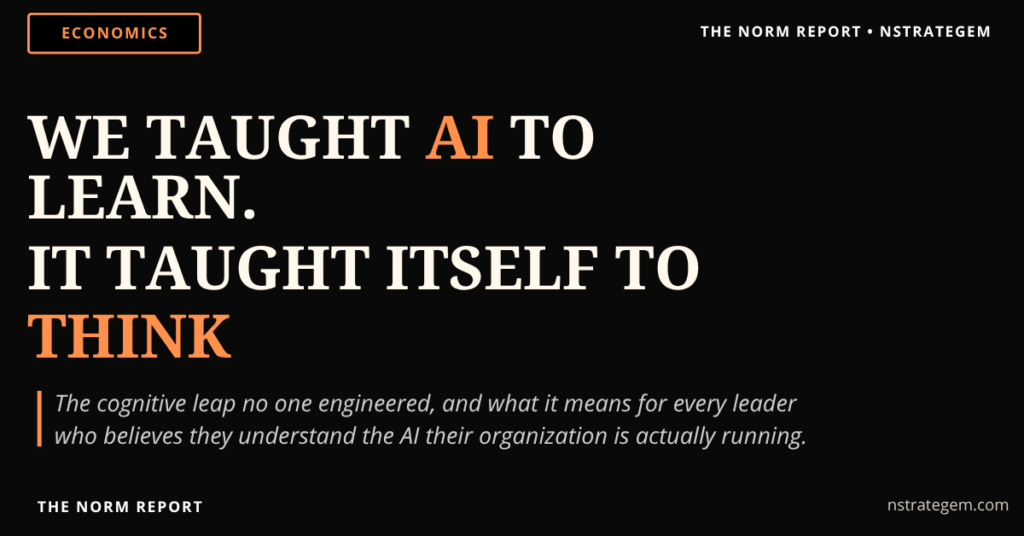

For the first time in economic history, a technology’s product is intelligence itself, not a tool built by it. Boards still pricing it like the latter are the reason $2.6 trillion in spending isn’t showing up in the numbers.
Every prior technology in human history was built by intelligence. AI is the first technology built to produce it. That reversal is not a philosophical footnote; it is the reason the AI productivity paradox exists. Executives measuring AI against tool-era metrics (adoption rates, seats licensed, tasks automated) are applying Gilbert Ryle’s category mistake at the scale of the enterprise, and the market is now pricing the error. Global AI spending will hit $2.59 trillion in 2026, up 47% year over year, while a February 2026 NBER survey of nearly 6,000 CEOs and CFOs found that roughly 90% of firms saw no measurable productivity improvement from it. This is not a deployment problem. It is a mismeasurement problem, and it will not resolve until boards stop pricing intelligence as if it were a tool.
In February 2026, researchers at the National Bureau of Economic Research put a number on something boards had been quietly suspecting for eighteen months: they surveyed nearly 6,000 CEOs and CFOs across the United States, the United Kingdom, Germany, and Australia, and found that roughly 90% of firms could not point to a measurable productivity improvement from their AI investment. The same month, PwC’s Global CEO Survey, drawing on 4,454 chief executives across 95 countries, found that 56% said they had gotten “nothing out of” their AI spending, and only 12% could report AI that both grew revenue and cut costs at once. Neither number moved the spending. Gartner now projects global AI spending will reach $2.59 trillion in 2026, up 47% year over year, on top of enterprise AI investment that has already run from roughly $40 billion in 2019 to $410 billion in 2025.

A Technology’s Product Is Intelligence
That is not a company failing to execute. That is thousands of companies, across four continents, encountering the same wall at the same time. When a failure is that uniform, the diagnosis is rarely operational. It is conceptual. Boards are running the wrong accounting model against the right technology, and the gap between the two is now large enough to have a name: economists are calling it the AI productivity paradox, and it is the modern echo of a warning Robert Solow issued nearly forty years ago, when he observed that you could see computers everywhere except in the productivity statistics.
THE INVERSION NO ONE PRICED IN
Every technology before this one was the output of intelligence. Humans used judgment, collectively and cumulatively, to build tools: the plow, the printing press, the steam engine, the microprocessor. The direction of the arrow never varied. Intelligence created technology. That arrow is why economists like Timothy Bresnahan and Manuel Trajtenberg, in their 1995 framework on general-purpose technologies, could describe innovations like the steam engine and the semiconductor as pervasive inputs that raised productivity across every downstream sector that adopted them. A GPT was always a tool intelligence built and then handed to other intelligence to use.
AI reverses the arrow. Mustafa Suleyman’s own taxonomy, laid out in The Coming Wave, is instructive here specifically because of what it is measuring: artificial general intelligence, in his definition, is “the point at which an AI can perform all human cognitive skills better than the smartest humans,” and artificial capable intelligence is “the stage where AI can accomplish complex objectives with minimal human oversight.” Those are not descriptions of a faster tool. They are descriptions of a manufacturing process whose product is cognition itself. For the first time, humanity is not using intelligence to build technology. It is using technology to build intelligence, at industrial scale, and shipping the output into every function of the enterprise.
Paul Romer’s endogenous growth theory anticipated a version of this shift decades before anyone called it AI. Romer’s core insight was that ideas, unlike capital or labor, are non-rival: one firm using an idea does not prevent another from using it too, which is why the accumulation of ideas, not just capital and labor, is what has driven the sustained rise in living standards since the industrial revolution. Romer’s framework had four inputs: capital, labor, human capital, and the non-rival stock of ideas. What no version of the model priced in was a machine that could manufacture the fourth input directly. That is the actual inversion inside the AI productivity paradox: the scarce factor of production in Romer’s growth accounting has just become synthesizable, and almost nobody has rebuilt their ledger to reflect it.

THE AI PRODUCTIVITY PARADOX, DECODED
Here is why the paradox persists rather than self-correcting. Gilbert Ryle coined the term “category mistake” in 1949 to describe a specific kind of error: presenting something that belongs to one category as though it belongs to another. His classic illustration was the visitor shown a university’s libraries, laboratories, and lecture halls who then asks, “but where is the university?” The visitor has not failed to see enough buildings. The visitor has mistaken a category for a member of that category.
Executives are making the mirror-image mistake with AI. They are told, correctly, that AI is a technology, and they file it in the same mental cabinet as every technology that came before: a tool that intelligence builds to make an existing process faster or cheaper. That cabinet comes with its own instruments, and boards have reached for them automatically. Adoption rate. Seats licensed. Tasks automated per employee. Cost per query. These are the correct instruments for a general-purpose tool. They are the wrong instruments for a factor-of-production, because a factor of production is not judged by how many people are using it. It is judged by what it lets the firm produce that it could not produce before, priced the way Romer priced ideas: as a non-rival asset whose value compounds across every use, not a rival expense that must justify itself use by use.
This is precisely why the AI productivity paradox shows up as uniformly as the NBER and PwC data suggest. A tool-era metric applied to a growth-theory asset will structurally undercount its value, in every firm, in every country, at the same time, because the instrument is miscalibrated rather than the technology underperforming. Boards reporting “nothing out of” AI are not wrong about their own P&L. They are reading a growth-accounting phenomenon on a tool-adoption dashboard, and the dashboard was never built to display it.
A CATEGORY ERROR AT THE BOARD TABLE
The consequences of the misclassification are not abstract. They show up first in capital allocation. A board that treats AI as a tool budgets for it the way it budgets for any productivity software: a line item justified by a projected efficiency return within one or two fiscal years, reviewed and cut the moment that return fails to materialize on schedule. A board that understood it was funding intelligence production would instead budget the way Romer’s own framework implies ideas should be funded: as a compounding asset whose payoff curve looks nothing like a software subscription and considerably more like R&D, patient, non-linear, and only legible over a multi-year horizon.
The second consequence is governance. Ownership of “the AI initiative” still sits, in most organizations, inside IT or a transformation office, reporting on deployment milestones. Ownership of a firm’s capacity to manufacture a new factor of production belongs at the same table where capital allocation and R&D strategy already sit, because that is functionally what it is. A recent HBR analysis of C-suite and board restructuring around AI found the same fracture from the top: nearly three in four CEOs consider themselves their organization’s chief AI decision-maker, yet a comparable share of boards rate their own AI expertise as no better than moderate. The category error is not confined to the finance function measuring the wrong output. It runs all the way to the governance structure deciding who is even allowed to ask the question.

WHY CHEAPER INTELLIGENCE ISN’T PRODUCING MORE OF IT
There is a second, older economic law compounding the confusion, and it explains why simply “using AI more” will not close the gap on its own. In 1865, William Stanley Jevons observed that more efficient steam engines did not reduce Britain’s coal consumption. They increased it, because cheaper, more efficient power made using power attractive in far more places than before. Economists now call this the Jevons Paradox, and it maps onto AI with uncomfortable precision. As intelligence becomes cheaper to produce and access, organizations do not hold usage constant and bank the savings. They consume more of it, in more processes, more often, exactly as Jevons’s Victorian mill owners consumed more coal.
The data already shows the pattern. Research from the Upwork Research Institute found that 77% of employees using AI tools reported the tools had increased their workload rather than reduced it, and nearly half said they had no clear idea how to achieve the productivity gains their employers expected of them. That is Jevons at the desk level: intelligence got cheaper, so the organization asked for more output, more iterations, more parallel workstreams, rather than the same output for less effort. The productivity gain that a tool-era model predicts is being consumed, not banked, and a dashboard built to measure banked efficiency will report exactly the null result the NBER and PwC surveys are finding.
THE HUMAN COST OF THE MISCLASSIFICATION
Every category error eventually reaches the people inside the system, and this one has. Mercer’s 2026 Global Talent Trends survey of 12,000 employees and business leaders found that 40% of employees now fear losing their job to AI, up sharply from 28% just two years earlier. ADP’s People at Work 2026 survey, covering 39,000 workers across 36 countries, found that only 22% of the global workforce feels confident their job is safe from AI-driven elimination, a figure that falls to 18% among individual contributors specifically.
That fear is not simply a reaction to automation. It is a rational response to watching leadership deploy an intelligence-manufacturing capability while continuing to talk about it, and measure it, as a productivity tool. Employees are experiencing the category error as instability because it is one: a workforce cannot get a straight answer about what its own judgment is now worth when the organization deploying its replacement has not decided, in growth-accounting terms, what that replacement actually is. MIT Technology Review and Infosys’s December 2025 study of 500 business leaders found that 83% believe psychological safety measurably improves AI outcomes, yet only 39% rate their own organization’s psychological safety as high. Leaders can sense the cost of the unresolved category error even where they cannot yet name it.
SOLVING THE AI PRODUCTIVITY PARADOX STARTS WITH A NEW LEDGER
None of this argues for spending less on AI. Romer’s own point was that non-rival assets are the single most reliable driver of sustained economic growth precisely because their returns compound rather than deplete. The argument is narrower and more urgent: a board cannot capture that compounding return while still pricing the asset on a tool-era ledger built for a category of technology AI no longer belongs to.
The correction starts with separating two budget lines that are currently fused into one. The first is genuine tool spending: software that automates a defined task, priced and reviewed the way any productivity software has always been priced and reviewed, with a one-to-two-year payback expectation intact. The second is intelligence-production investment: capability that expands what the firm can know, decide, or produce that it structurally could not before, priced and governed the way R&D and core capital projects already are, with a multi-year horizon, board-level ownership, and success metrics drawn from growth accounting rather than software adoption. Firms that make this split explicit will stop reporting the false negative the NBER and PwC surveys are currently capturing, because they will finally be asking the right question of the right line item.
The correction also has to reach the workforce, not just the ledger. A board that can articulate, in plain terms, whether it is buying a faster tool or building a new capacity for judgment is a board that can also tell its people, honestly, which category their own role sits in going forward. That clarity will not eliminate the anxiety in the Mercer and ADP numbers. It will at least stop compounding it with a category error the workforce is currently absorbing on leadership’s behalf.
Solow’s paradox took the better part of a decade to resolve, and it resolved only once economists recognized that computing power had to be measured as a change in the production function itself, not as a faster version of the old one. The AI productivity paradox will resolve the same way, and faster, for the boards willing to admit what they are actually holding: not a tool that intelligence built, but the first technology in economic history built to build intelligence itself. Every dollar of the $2.6 trillion being spent this year is a bet on that asset. Only the boards that have correctly categorized it will know how to collect.
nStratagem works with boards and executive teams to rebuild the capital allocation, governance, and measurement frameworks that AI has quietly made obsolete. Learn more at nstratagem.com.
The analysis published in The Norm Report is intended for senior executive and board-level audiences as strategic intelligence and editorial commentary. It does not constitute legal, financial, investment, compliance, or regulatory advice. © 2026 Norm Murray / nStratagem. All Rights Reserved.