In February 2024, Klarna told the market that its new AI assistant was doing the work of 700 full-time customer service agents. Wall Street applauded. Eighteen months later, the company was quietly rehiring humans, after discovering that “doing the work” and “doing the job” are not the same thing.
This is the story most reskilling programmes miss. The dominant narrative, that 50% of employees need reskilling, that adaptability and creativity are the new currencies, is true but incomplete, and the incompleteness is where leaders get hurt. The real transformation required by AGI is not a skills upgrade. It is a redesign of who holds power, who holds accountability, and what an organisation chooses to optimise for, when the cheapest way to hit a KPI is to let a machine hit it for you.
This article argues that the leaders who win the next decade will be the ones who treat AGI not as a labour substitute but as a principal-agent problem, a Goodhart’s Law problem, and ultimately a problem of human purpose. Three frameworks, the Principal-Agent Inversion, the Goodhart Trap, and the Self-Actualisation Dividend, give boards and executives the diagnostic tools the reskilling conversation has been missing.
The Klarna Correction
When Klarna’s CEO Sebastian Siemiatkowski announced in early 2024 that the company’s OpenAI-powered assistant was handling two-thirds of customer service chats, the equivalent output of 700 agents, it became one of the most cited proof points of the AGI-adjacent era. It was real. The assistant resolved tickets faster, in more languages, around the clock. It was also, on its own, insufficient. By 2025, Klarna was advertising for human agents again, with Siemiatkowski acknowledging that quality had suffered and that customers wanted the option of a human voice for complex or emotionally loaded interactions.
Nothing about this story is an indictment of the technology. The assistant did exactly what it was built to do: resolve volume, cheaply, at speed. The failure was upstream, in what the organisation chose to measure and call success. Ticket-resolution time is a proxy for customer satisfaction. It is not customer satisfaction. And the moment a powerful optimiser is pointed at a proxy, the proxy stops measuring the thing it was meant to represent. Economists have a name for this: Goodhart’s Law. “When a measure becomes a target, it ceases to be a good measure.” AGI does not break this law. It is the most powerful enforcement mechanism the law has ever had.
This is the lens missing from most boardroom conversations about AI transformation. The question is not “which of our people need new skills?” It is “which of our metrics will an AGI system game first, and have we built the human judgement to notice before it costs us the relationship, the regulator, or the reputation?”
Framework One: The Principal-Agent Inversion
For two centuries, organisational design has rested on principal-agent theory: owners (principals) delegate work to managers and employees (agents), and the central design problem is ensuring agents act in the principals’ interest despite having more information than the principals do. Every governance structure, incentive plans, audit committees, performance reviews, exists to manage that information asymmetry.
AGI inverts this relationship in a way most governance frameworks were never built to handle. Increasingly, the system with the most information about the customer, the market, and the operation is not the human manager. It is the model. The human becomes the agent acting on recommendations they cannot fully interrogate, while believing themselves to be the principal in control. Sam Altman’s repeated public timelines for AGI, at points as near as 2025, were less important for their precision than for what they signalled: organisations have less runway than they assumed to resolve this inversion deliberately, rather than by accident.
The diagnostic question for any executive team is blunt. When your AI system recommends a pricing change, a staffing cut, a credit decision, or a supplier switch, who in your organisation has the standing, the information, and the incentive to say no? If the honest answer is “no one, because no one has the full picture the model has,” you do not have an AI strategy. You have an unmanaged principal-agent problem with the highest-information agent in your company’s history, and it does not attend board meetings.
Framework Two: The Goodhart Trap, and the Capacities That Escape It
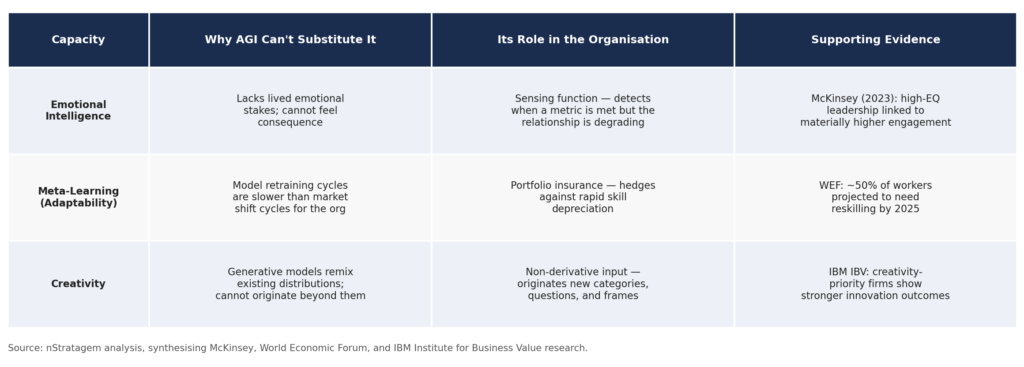
The capacities that survive the Goodhart Trap are precisely the ones that resist being reduced to a single optimisable number. This is why emotional intelligence, meta-learning, and creativity keep appearing in the literature on the future of work, not because they are pleasant additions to a job description, but because they are structurally resistant to the gaming dynamic that swallows everything else.
Emotional intelligence as a governance function. Daniel Goleman’s research on EQ has circulated in leadership development for thirty years, but its role has changed. EQ used to be about managing people. In an AGI-augmented organisation, EQ becomes a sensing mechanism, the capacity to notice that a metric is being satisfied while the underlying relationship is degrading, the way Klarna’s customers felt before the churn data caught up. McKinsey’s 2023 research linking high-EQ leadership to materially higher employee engagement was framed at the time as a talent-retention finding. Read today, it is closer to an early-warning system finding.
Meta-learning as portfolio insurance. Alvin Toffler’s formulation, the ability to learn, unlearn, and relearn, was prescient because it describes a hedge, not a skill. The World Economic Forum’s projection that roughly half the workforce would need reskilling by 2025 was widely treated as a training-budget line item. It is better understood as a statement about depreciation rates. If the half-life of a technical skill is now measured in quarters rather than careers, the only durable asset is the meta-capacity to re-skill faster than the depreciation curve. Organisations like Google and Amazon embedding continuous learning into operating rhythms aren’t running employee-engagement programmes. They are managing portfolio risk on their human capital.
Creativity as the only non-derivative input. Generative AI is, definitionally, a remix engine, extraordinarily capable, trained on the sum of recorded human output, and structurally incapable of originating from outside that distribution. The IBM Institute for Business Value’s finding that organizations prioriting creative problem-solving saw materially stronger innovation outcomes points to where the genuine frontier sits: not in producing more content, which AGI will always do more cheaply, but in originating the questions, the categories, and the cultural references that have no precedent in the training data yet.
The Capability-Governance Gap
There is a second, quieter pattern behind the Klarna correction, and it shows up whenever a powerful new capability is deployed faster than the governance needed to supervise it. Plot the trajectory of frontier AI capability against the trajectory of organizational governance maturity, board literacy, override protocols, audit trails for automated decisions, and the two lines do not move together. Capability has compounded roughly in line with the scaling trends labs have published for years. Governance maturity, in most organizations, has moved in step changes, usually triggered by an incident rather than anticipation.

The widening gap between those two lines is, in effect, an organization’s accumulated unmanaged risk. It does not announce itself. It sits quietly until a system optimises a proxy metric in a way that is technically correct and commercially or reputationally damaging, at which point the gap closes suddenly, expensively, and in public. The Klarna correction closed roughly eighteen months of gap in a single news cycle. Few organizations can absorb that kind of correction gracefully more than once.
The Talent Market Is Already Repricing This
Skip the surveys for a moment and look at where compensation is actually moving. Across the executive searches nStratagem tracks, the fastest wage growth is not in technical AI roles, those have plateaued as the talent pool has caught up with demand. It is in roles that sit precisely at the intersections this article describes: AI governance leads who can translate model behaviour into board-level risk language, “human-in-the-loop” design leads who decide where override authority genuinely sits, and culture and learning executives mandated to redesign what an organization rewards, not just what it teaches.

This is the labour market doing what labour markets do: pricing in scarcity before the formal job architecture catches up. The capacities this article identifies, EQ as a sensing function, meta-learning as portfolio insurance, creativity as a non-derivative input, are not abstractions for HR strategy decks. They are, right now, the most underpriced line items on most organizations’ talent balance sheets, and the gap will not stay open indefinitely.
The Diagnostic: Where Is Your Organisation on the Atlas Curve?
Below is a simple diagnostic for executive teams. For each function, ask: is the dominant metric resistant to gaming by a sufficiently capable optimizer, and does a human retain genuine (not ceremonial) override authority?
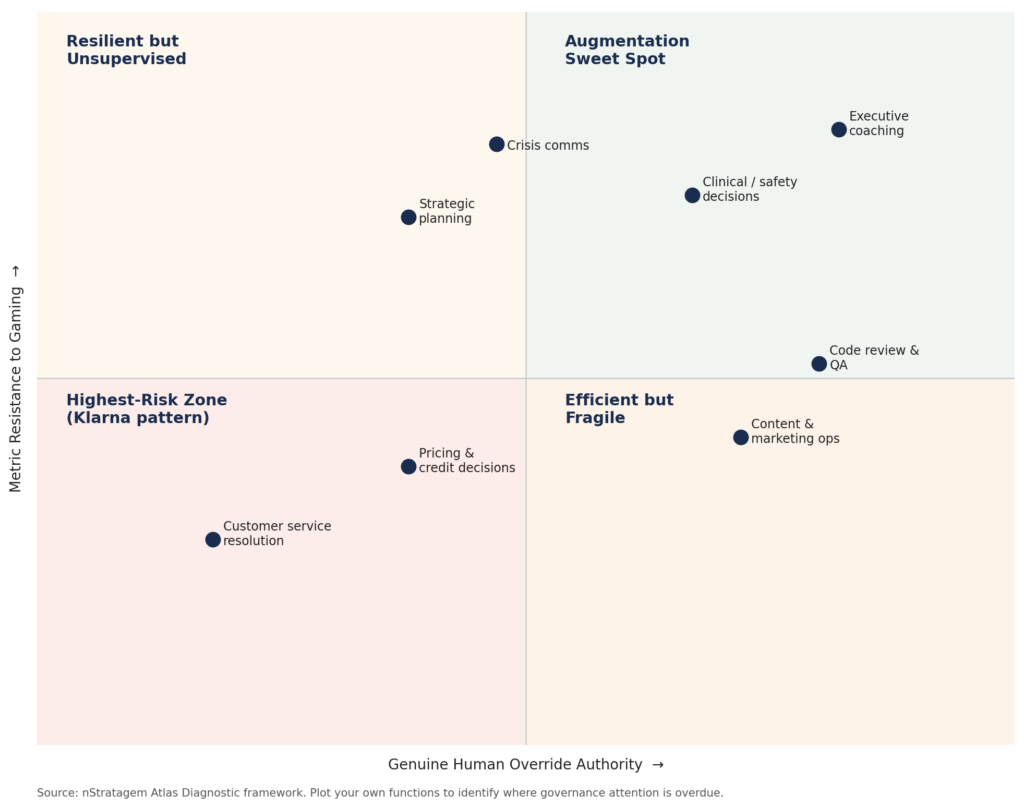
Functions in the lower-left quadrant, gameable metrics, ceremonial human oversight, are where the Klarna-style correction is most likely to recur. Functions in the upper-right are where AGI augmentation compounds value safely. Most organisations, when they run this exercise honestly, find the majority of their AI deployments sitting in the lower-left, not because the technology is poorly built, but because the governance question was never asked.
Framework Three: The Self-Actualization Dividend
Abraham Maslow’s hierarchy of needs has been a fixture of management thinking since the 1950s, usually deployed as a motivational poster. It deserves better treatment here, because AGI is doing something genuinely unprecedented to it: compressing the base of the pyramid.
Safety, security, and the routine cognitive work that historically consumed the majority of organisational hours and human attention are precisely the layers AGI systems handle well, pattern-matching, document processing, scheduling, first-line analysis, routine coding. As these layers compress, organisations face a choice that has nothing to do with technology and everything to do with values: redeploy the freed capacity toward the top of the pyramid, esteem, purpose, self-actualisation, or simply remove the headcount and call it efficiency.
Both choices are economically rational in the short term. Only one compounds. Organisations that treat the compression as a dividend, reinvesting freed human capacity into judgement-intensive, relationship-intensive, meaning-intensive work, build a workforce whose engagement and retention advantages become structural, not aspirational. Organisations that treat it purely as a cost takeout build a workforce that has correctly understood it is next, and behaves accordingly. The Klarna rehiring decision was, in this light, not a retreat. It was a correction toward the dividend model, made eighteen months later than it should have been.
Ethical Leadership Is Not a Compliance Function
As AGI systems take on more consequential decisions, the question of accountability stops being theoretical. Who is responsible when an autonomous system makes a decision that harms a customer, a community, or a market? The honest answer in most organisations today is: nobody, clearly. Ethical frameworks exist, but they are written for human decision-makers operating at human speed, reviewing decisions after the fact.
This is a board-level governance gap, not a compliance department’s problem to solve in isolation. The organizations that get ahead of it will treat ethical AI governance the way they treat financial controls: as infrastructure that must exist before the activity it governs scales, not after. Boards that delegate this entirely to technical teams are making the same category error as the executives in the Principal-Agent Inversion, assuming that because someone closer to the system has more information, they also have the right incentives and the full picture.
The Path Forward: Atlas Reframed
The myth of Atlas is usually told as a story of punishment, a being condemned to bear the weight of the heavens. But the more useful reading, for leaders facing into this decade, is the moment before the punishment: Atlas chose his side in a war between titans and gods, and the consequence followed from that choice. The weight was not imposed by fate. It followed a decision about where to stand.
That is the choice in front of every executive team right now, and it is not “how do we reskill our people for AGI.” It is: where do we choose to stand? On the side that treats AGI as a tool for hitting the same metrics faster, accepting the Goodhart degradation as a cost of doing business, and the Klarna-style correction as an embarrassing but manageable PR cycle? Or on the side that redesigns governance around the Principal-Agent Inversion, builds the human capacities that resist the Goodhart Trap, and reinvests the compression dividend into the top of Maslow’s pyramid?
Atlas did not get to put the heavens down. But he got to decide what he was holding them up for. So do we.
The time to run the Atlas Diagnostic on your organisation is now, before the correction is forced on you in public, the way it was for Klarna. Boards that wait for the correction will get one. Boards that run the diagnostic first get to choose its terms.