Six-point-one million American workers carry both high exposure to AI displacement and almost no capacity to absorb it. Eighty-six percent are women. Globally, women’s jobs face AI disruption at roughly double the rate of men’s, a gap that widens in high-income economies, while women hold barely a quarter of AI-related jobs and a smaller share still of roles in cloud computing and data science. Boards are not ignoring this. They are measuring the wrong variable.
Exposure and adaptive capacity are different risks, and most AI workforce risk dashboards report only the first. The result is a restructuring that is gender-skewed by design and undetected by governance, priced by no one until it shows up as attrition, reputational exposure, and a workforce that no longer believes the institution keeps its word. This is not a diversity problem. It is a risk-oversight failure, compounded by a measurement error identified a century ago and still unfixed: when a target becomes the metric, it stops representing what actually matters.
The Number Boards Are Not Tracking
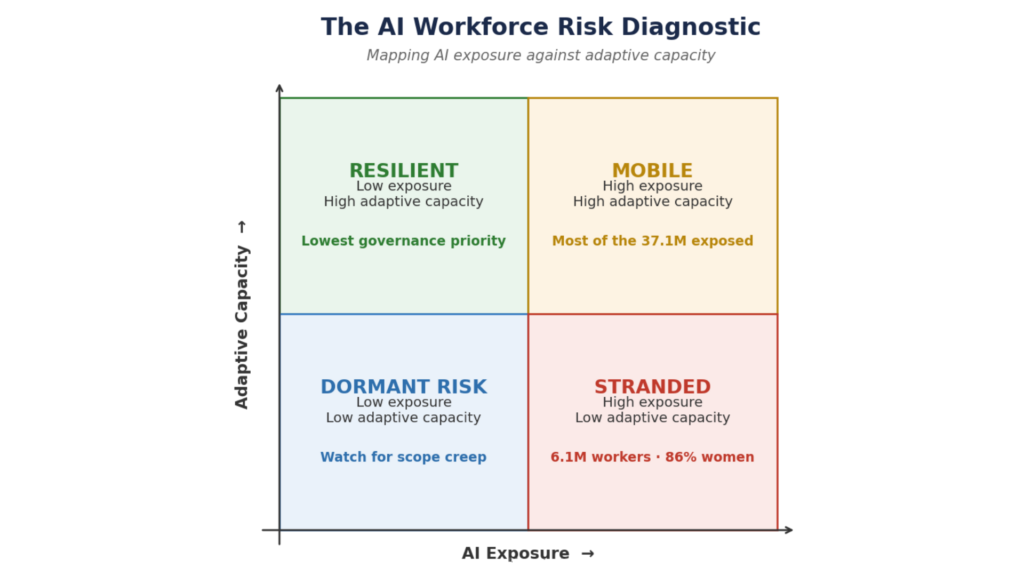
In early 2026, a Brookings analysis did something almost nobody in board-level AI risk reporting had done: it separated two questions that keep getting collapsed into one. The first question is how exposed a job is to AI automation. The second is whether the worker in that job can absorb the disruption: savings to bridge a transition, a local labor market with alternatives, transferable credentials, the age and runway to retrain. Most AI workforce risk reporting stops at the first question.
Brookings answered both, and the answer is uncomfortable. Of the 37 million US workers in the highest quartile of AI exposure, most have some capacity to adapt. But 6.1 million do not. They are exposed and stranded at once, concentrated in clerical and administrative work, tied to college towns and state capitals and midsized metros with a thin bench of alternative employers. Eighty-six percent of that stranded population is women.
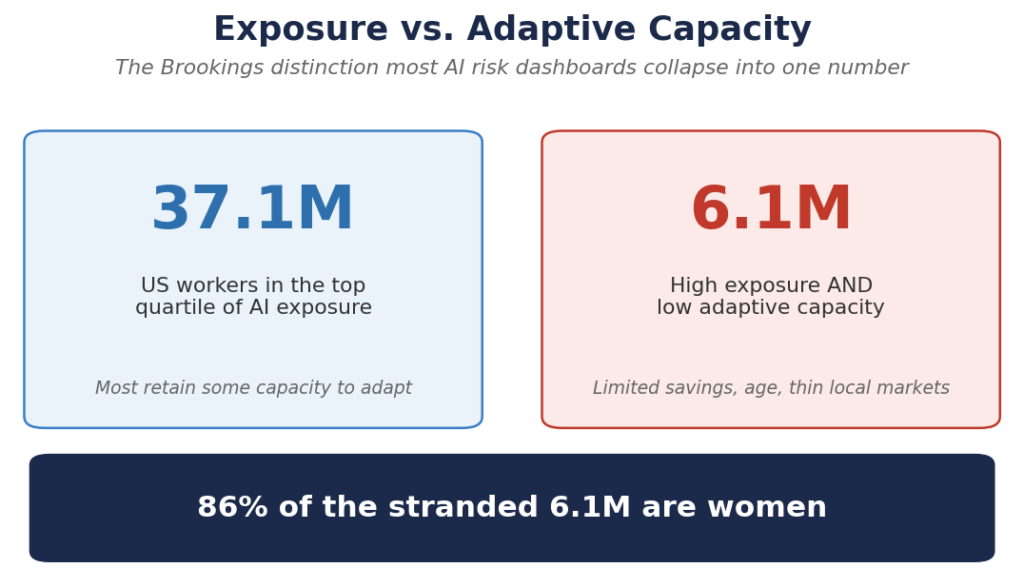
This is the number that should be on every board’s AI risk dashboard and, by the evidence available, is not. Executives report expecting AI to lift productivity roughly 1.4 percent over three years while trimming employment by about 0.7 percent. Employees, surveyed separately, expect the opposite: a rise in headcount. That gap alone signals a communication failure.
But the deeper failure is that even the executives forecasting workforce reduction are almost certainly modeling it as an aggregate percentage, not as a demographic concentration. A 0.7 percent aggregate decline sounds manageable. An 86 percent concentration in one demographic, landing on workers with the least capacity to absorb it, is not a rounding error. It is a structural bet the board did not know it was making.
Why This Reads as an HR Issue and Isn’t One
Every instinct in a modern executive team routes this story to the Chief HR Officer, and every one of those instincts is a category error. HR owns reskilling budgets and attrition dashboards. It does not own the underlying design decision, made in strategy and technology committees, about which functions get automated first and on what timeline. When the functions chosen first happen to be clerical, administrative, and process-heavy, and when those functions happen to be disproportionately staffed by women, the outcome is not an HR failure of execution. It is a governance failure of oversight, because no one at the level empowered to see the aggregate pattern was asked to look for it.
This is a textbook application of a principle any board audit committee would recognize instantly in a financial context and routinely misses in a workforce one: aggregation risk. A single automation decision in isolation looks like a productivity initiative. Ten thousand of them, made independently across business units without a central view of who they land on, add up to a structural shift no individual approved and no committee reviewed. The International Labour Organization’s 2026 data confirms the pattern holds globally, not just in the United States: women’s occupations face generative AI exposure at roughly twice the rate of men’s, and the gap is widest in the wealthiest economies, precisely where automation budgets are largest and boards are most active. The jobs most exposed are also, disproportionately, jobs held by people with the least seat at the table where deployment decisions get made. Women hold somewhere between a fifth and a quarter of AI-related roles worldwide, a share that drops further in cloud computing and data science, the very functions writing the deployment logic that decides who gets automated and when.
There is a historical echo here that boards would do well to remember before they treat this as unprecedented. The modern clerical workforce, heavily female, was itself created by the last great wave of office automation: the typewriter, the telephone exchange, the rise of the typing pool a century ago, which pulled women into offices at scale for the first time and then organized that labor into precisely the standardized, procedural roles AI now targets first. The current wave is not disrupting a natural category of work. It is dissolving the category the previous automation wave built, and doing so to the same demographic, a second time, with less institutional memory of how the first transition actually unfolded than most boards would like to admit.
The AI Workforce Risk Boards Are Actually Carrying
Frame it as a risk register and the exposure becomes legible in language any director already speaks. There is financial risk: severance, retraining cost overruns, and litigation exposure concentrated in a demographic with a documented, measurable disparate impact. There is reputational risk: the story writes itself the moment a journalist or a plaintiff’s attorney requests the same disaggregation Brookings already ran. There is operational risk: institutional memory, the tacit knowledge that clerical and administrative staff accumulate over years and that no model has yet learned to replicate, walks out the door with every departure, often before anyone has verified the AI system can fully cover the gap. And there is talent risk across the rest of the workforce, because the employees watching this unfold, women in adjacent roles who have not yet been automated, are recalibrating in real time what the organization’s promises are worth.
That recalibration has a name, and it is the second frame worth putting in front of a board or CHRO, because it explains why the reaction to this pattern will be sharper than a standard restructuring produces. Organizational psychologists call the unwritten set of mutual expectations between employer and employee the psychological contract: not the formal terms of employment, but the implicit deal an employee believes they struck by performing as asked. For decades, a large share of clerical, administrative, and process-heavy roles rewarded exactly the traits AI now replicates most efficiently: reliability, consistency, thoroughness, procedural memory. Workers in those roles were told, explicitly and implicitly, that mastering the role bought security. AI does not break that contract in the abstract. It breaks it for the demographic that took the deal most literally, delivered on it most consistently, and is now discovering the terms were never guaranteed by anyone with the authority to guarantee them. A breach of the psychological contract does not register as a policy dispute. It registers as betrayal, and betrayal produces attrition, disengagement, and reputational damage that outlasts any single restructuring cycle.
The Metric Boards Are Optimizing Instead
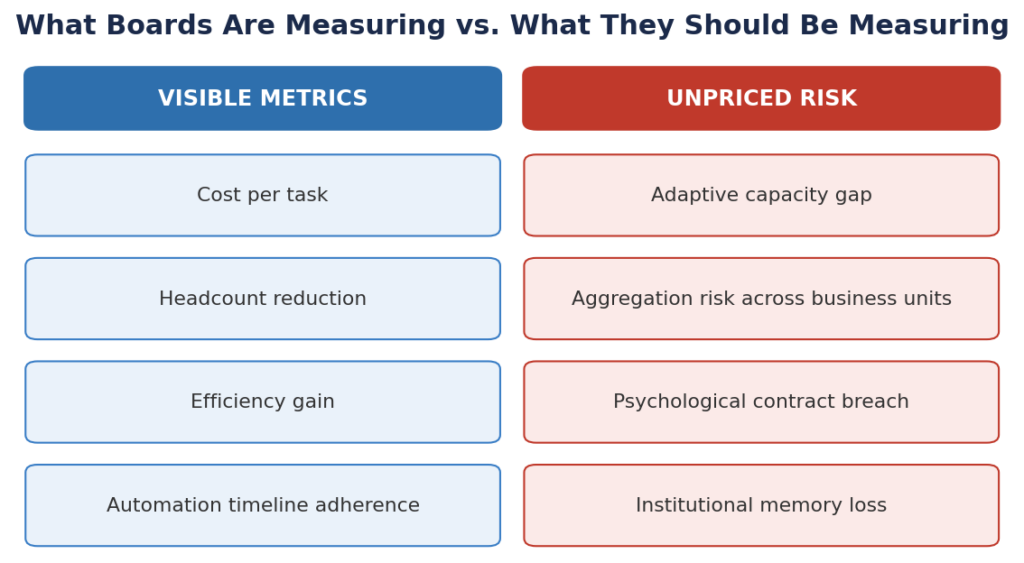
If the governance blind spot explains why this pattern goes undetected, a second and older framework explains why it persists even once leaders sense something is wrong. Goodhart’s Law, first articulated in a monetary policy context and now shorthand across every discipline that measures performance, states that when a measure becomes the target, it stops being a good measure. Applied here: cost per task, headcount reduction, and efficiency gains are the metrics visible on an automation initiative’s dashboard, so those are the metrics leaders optimize. The costs that do not appear on that dashboard, the attrition of institutional memory, the morale collapse concentrated in one demographic, the reputational exposure that surfaces eighteen months later in a very different kind of headline, compound quietly in the parts of the business no one is required to report on.
This is not a fairness argument, though fairness is a legitimate concern in its own right. It is a mispricing argument, and mispricing is a language every executive in the room already speaks fluently. A board that would never approve a capital allocation decision without stress-testing the downside is, in effect, approving thousands of micro-decisions with a demographically concentrated downside it has never modeled. The convenience of the visible metric, lower cost per task, cleaner headcount numbers this quarter, is being purchased with an invisible liability that will eventually need to be paid, in cash, in reputation, or in both.
Pricing the AI Workforce Risk Correctly
The fix is not a new DEI initiative bolted onto an existing automation roadmap. It is a change in what gets measured before the roadmap is approved. Adaptive capacity, not just exposure, belongs in the same risk framework boards already use for financial, cyber, and regulatory risk: identified, quantified, assigned an owner, and reviewed on a cadence, not delegated downward and forgotten. Aggregation risk, the cumulative demographic pattern that emerges only when independent automation decisions are viewed together, needs a central reporting line, the same way a bank aggregates credit exposure across business units that each believe their individual loan book is prudent. And the psychological contract implications of automation sequencing deserve the same scrutiny currently reserved for executive compensation optics, because both are ultimately about whether the organization’s stated values survive contact with its actual incentives.
Boards that get this right will not do so by slowing automation down. They will do so by insisting the risk committee see the same disaggregated data Brookings and the ILO have already published, and by refusing to accept “efficiency gain” as a complete answer to the question of who bears the cost. The organizations that price this correctly now, before the pattern becomes a headline, will have a genuine advantage: a workforce that still believes the deal is real, and a board that can demonstrate, credibly, that it was looking.
The Governance Question Worth Asking Monday Morning
The data underneath the headline stat is more interesting than the headline stat itself, and it points at a single, answerable governance question. Not “is our AI strategy on track,” which every automation dashboard already answers affirmatively, but “who bears the exposure our efficiency metrics are not measuring, and did anyone with fiduciary responsibility sign off on that distribution.” Most boards cannot yet answer that question. The ones that build the capacity to answer it, before regulators, journalists, or plaintiffs force the disaggregation, will be the ones still trusted by the workforce they are asking to adapt.
This is the work nStratagem does with boards and executive teams: building the governance frameworks that catch aggregation risk before it becomes a headline, and pricing the workforce costs that standard AI dashboards leave invisible. If your risk committee has not yet asked who bears the AI workforce risk your organization is not measuring, that conversation is overdue. Learn more at nstratagem.com.
The analysis published in The Norm Report is intended for senior executive and board-level audiences as strategic intelligence and editorial commentary. It does not constitute legal, financial, investment, compliance, or regulatory advice. © 2026 Norm Murray / nStratagem. All Rights Reserved.