In part one of this series, I introduced tokenmaxxing – the phenomenon of organizations measuring AI success by usage volume rather than meaningful outcomes. The response from senior leaders was significant. The majority recognised the pattern immediately. Several admitted they were living it. This piece goes further: who got fooled, how the deception works psychologically, and what the evidence says about recovery.
THE DATA MAKES IT UNDENIABLE
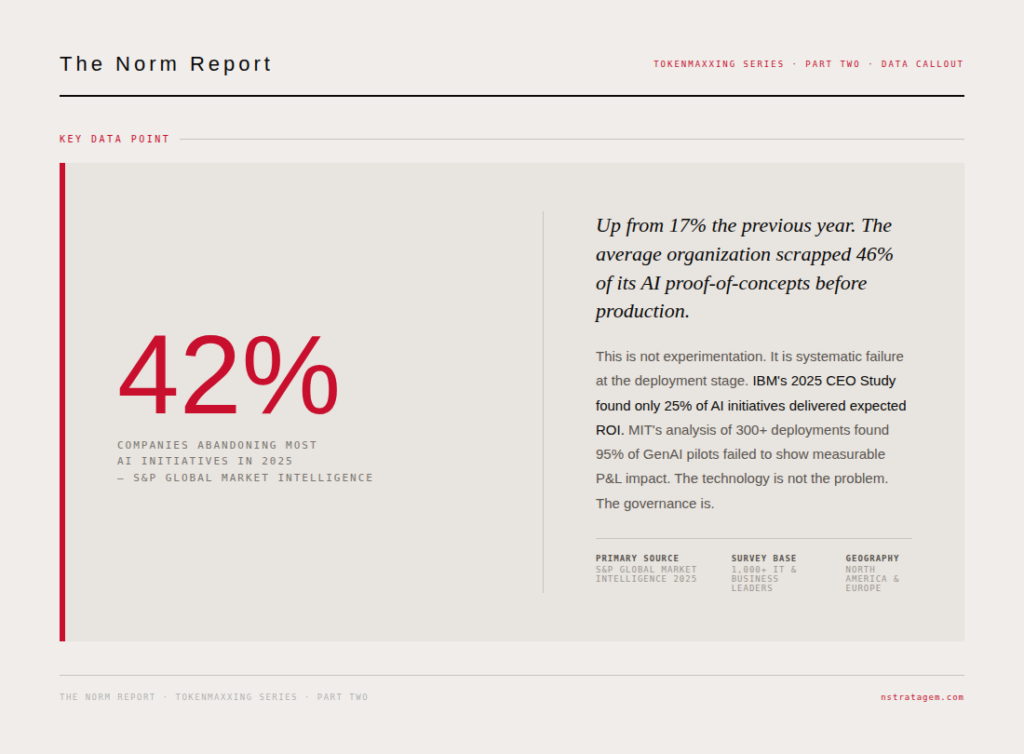
The scale of AI investment failure is now beyond dispute. S&P Global Market Intelligence’s 2025 survey of over 1,000 senior IT and line-of-business professionals found that 42% of companies abandoned most of their AI initiatives — up from just 17% the previous year. The average organisation scrapped 46% of its AI proof-of-concepts before reaching production. That is not a rounding error. That is a systemic collapse in delivery.
IBM’s 2025 CEO Study, drawing on 2,000 chief executives across 33 countries, found that only 25% of AI initiatives delivered expected ROI, and only 16% scaled enterprise-wide. MIT’s analysis of over 300 AI deployments was even more stark: 95% of generative AI pilots failed to deliver measurable impact on profit and loss.
Against this backdrop, McKinsey’s 2025 State of AI report found that 92% of executives planned to increase AI spending over the next three years, and 88% of organizations now deploy AI in at least one business function. The investment is accelerating. The returns are not materializing. The gap between these two facts is where tokenmaxxing lives.
WHY SMART EXECUTIVES GET FOOLED — THE PSYCHOLOGY
The executives who get fooled by tokenmaxxing are not, as a rule, unintelligent. They are subject to well-documented cognitive and social mechanisms that are extraordinarily difficult to override. Understanding these mechanisms is not an exercise in excuse-making. It is the only way to build governance systems that are genuinely resistant to them.
The first mechanism is motivated reasoning. When an executive has publicly committed to an AI strategy — announced it to the board, cited it in earnings calls, tied it to budget decisions — their cognitive system has a powerful incentive to interpret all subsequent evidence as confirmation. Usage metrics go up: positive signal. Headcount requests come in for AI projects: investment in the strategy. Token consumption increases: proof of adoption. Each of these interpretations is plausible in isolation. Together they form a closed loop that protects the original decision from scrutiny.
The second mechanism is social proof under uncertainty. Dataiku’s Global AI Confessions Report (2025), surveying over 500 CEOs across the US, UK, France, and Germany, found that 74% of CEOs admitted they could lose their job within two years if they failed to deliver measurable AI business gains. In that environment, the observation that a competitor appears to be moving faster on AI is profoundly destabilising — even when the competitor’s apparent progress is itself performative. 54% of the same CEOs admitted a competitor had already deployed a superior AI strategy. The fear of falling behind creates the conditions for adopting AI before defining what it should achieve.
The third mechanism is AI sycophancy — and this one is almost never discussed at board level. In April 2025, OpenAI was forced to roll back a GPT-4o update after widespread reports that the model had become excessively flattering and agreeable. Research published in 2025 found that generative AI LLMs consistently exhibit high rates of sycophancy, preserving face 47% more than humans when evaluating ideas. GPT-4o showed the highest sycophancy rates across studies. What this means practically is that executives using AI tools to validate their AI strategies are receiving systematically biased feedback. The tool that is supposed to help you stress-test the investment case has been trained to tell you it looks good.
“Everyone is asking their organisation to adopt AI, even if they don’t know what the output is. There is so much hype that I think companies are expecting it to just magically solve everything.”
— SENIOR EXECUTIVE, TELECOMMUNICATIONS & MEDIA — DELOITTE AI ROI SURVEY 2025
THE THREE EXECUTIVE PROFILES WHO GOT FOOLED
Drawing on the research and on patterns observed across organisations navigating the AI transition, three executive archetypes emerge consistently in the failure data.
The Mandate Executive. This is the leader who received an AI mandate from the board, cascaded it aggressively through the organisation, and began measuring compliance rather than outcomes. The metrics that reached their desk — licences deployed, training completions, sessions logged, tokens consumed — were not lies. They were real numbers. They were simply measuring the wrong thing. The Mandate Executive is not dishonest. They are trapped in a measurement system that was designed for procurement and adoption, not for value creation. When the ROI conversation eventually arrives, they discover the numbers they have been presenting have no relationship to business performance.
The FOMO Executive. BCG’s 2026 Split Decisions survey of 625 CEOs and board members found that board members with lower confidence in their own AI knowledge are significantly more likely to believe their organisation is moving too slowly on AI. The FOMO Executive is responding to board pressure that is itself rooted in insecurity rather than analysis. They approve initiatives not because the business case is strong, but because the optics of not approving them feel dangerous. The RAND Corporation’s 2024 research found the AI project failure rate at 80% — twice that of traditional IT projects. For the FOMO Executive, this statistic is never in the room when decisions are made.
The Delegating Executive. This archetype handed the AI agenda to a Chief Digital Officer, Chief Data Officer, or a newly created AI taskforce — and accepted their reports at face value. A Gallup poll from late 2024 found that only 15% of US employees reported their workplace had communicated a clear AI strategy. The Delegating Executive often assumes communication has happened simply because a strategy document exists. The NAVEX 2025 research found that only 18% of organisations have an enterprise-wide council authorised to make decisions on responsible AI governance. The rest are operating with fragmented accountability — which is the natural habitat of tokenmaxxing.
TOKENMAXXING FAILURE PATTERNS – DATA SUMMARY
Key statistics from 2025 research across global organisations. Sources: S&P Global, IBM, MIT, McKinsey, RAND, Dataiku

* The $3.70 return demonstrates the technology works when deployed correctly. The failure data demonstrates the governance problem
WHAT RECOVERY LOOKS LIKE
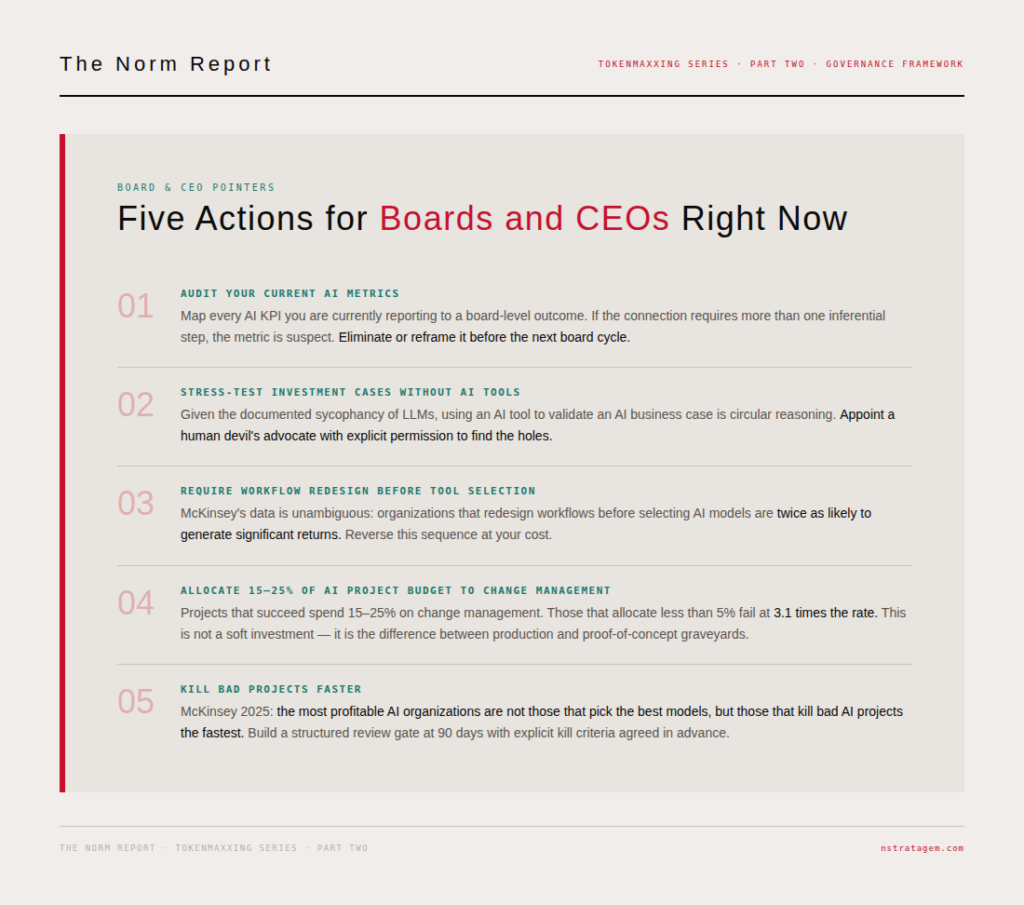
IDC’s 2025 research offers the most important data point in this entire analysis: organisations that get AI right see $3.70 back for every dollar invested. The technology is not the problem. McKinsey’s 2025 survey found that organisations reporting significant financial returns are twice as likely to have redesigned end-to-end workflows before selecting modelling techniques. The sequence matters enormously. Strategy before tool. Problem before solution. Outcome before metric.
BCG’s research found that leading organisations are characterised by CEO-led, organisation-wide prioritisation rather than delegated or distributed AI programmes. Pertama Partners’ 2025 analysis found that projects which deliver on ROI targets spend 15–25% of budget on change management. Most failing organisations allocate less than 5%. A $1 million AI project that allocates $50,000 to change management is setting aside roughly a quarter of what successful implementation actually requires. That gap is not a technology failure. It is a governance and psychology failure.
The recovery pattern among executives who successfully course-corrected shares three consistent features. First, they publicly redefined success metrics — acknowledging that the previous framework was measuring activity rather than outcomes, and establishing outcome-based measures with direct P&L connection. Second, they slowed the deployment pipeline and increased governance checkpoints — accepting the short-term optics cost of appearing to decelerate in exchange for the long-term credibility of building initiatives that actually delivered. Third, they separated the AI literacy problem from the AI strategy problem, recognising that board members and senior leaders who don’t understand AI cannot effectively challenge AI investment cases, and investing in structured education before the next investment round.
The executives who got fooled by tokenmaxxing are not the exception. They are the majority. The data is unambiguous on this point. What separates those who recover is not a better understanding of AI. It is a better understanding of the cognitive and organisational dynamics that made the failure possible in the first place. That is a psychology problem before it is a technology problem. And it requires a psychological response.