There is a word for a communication strategy that deploys fear to neutralize critical thinking, manufacture consent, and position a single actor as the only viable protector against a threat that actor helped create. The word is psyop. And the AI industry has been running one in plain sight for years.
The BBC recently published a detailed accounting of the pattern. Claude Mythos, Anthropic’s latest model, was declared powerful enough to cause “catastrophic” harm. A blog post invoked economic collapse, public safety, and national security in a single paragraph. The model was withheld – not released. You were told. The implication: be grateful someone responsible is holding the trigger.
This isn’t a product launch. It’s a persuasion operation. And if you’re a senior executive making decisions about AI adoption, regulation posture, or capital allocation, you need to understand the mechanics.
The architecture of manufactured fear
Behavioral psychologists have a name for what happens when an authority figure presents an overwhelming existential threat and simultaneously offers themselves as the only credible solution. It’s called the savior-threat dyad, and it exploits two cognitive vulnerabilities simultaneously: the amygdala’s threat-detection circuitry, which bypasses analytical reasoning, and the brain’s tendency to defer to apparent expertise under conditions of uncertainty.
The AI industry didn’t invent this. Tobacco companies funded cancer research. Defense contractors testified before the committees that approved their contracts. What’s novel here is the scale and the target. The audience isn’t just consumers, it’s regulators, legislators, and institutional investors. When Anthropic says “the fallout could be severe,” it isn’t warning the public. It’s talking to Capitol Hill.
Shannon Vallor, AI ethics professor at the University of Edinburgh, put it bluntly in the BBC piece: portray the technology as “almost supernatural in its danger” and you make people feel powerless, as if “the only people we could possibly look to would be the companies themselves.” That’s not a warning. That’s market capture framed as public service.
The pattern is documented, not theoretical
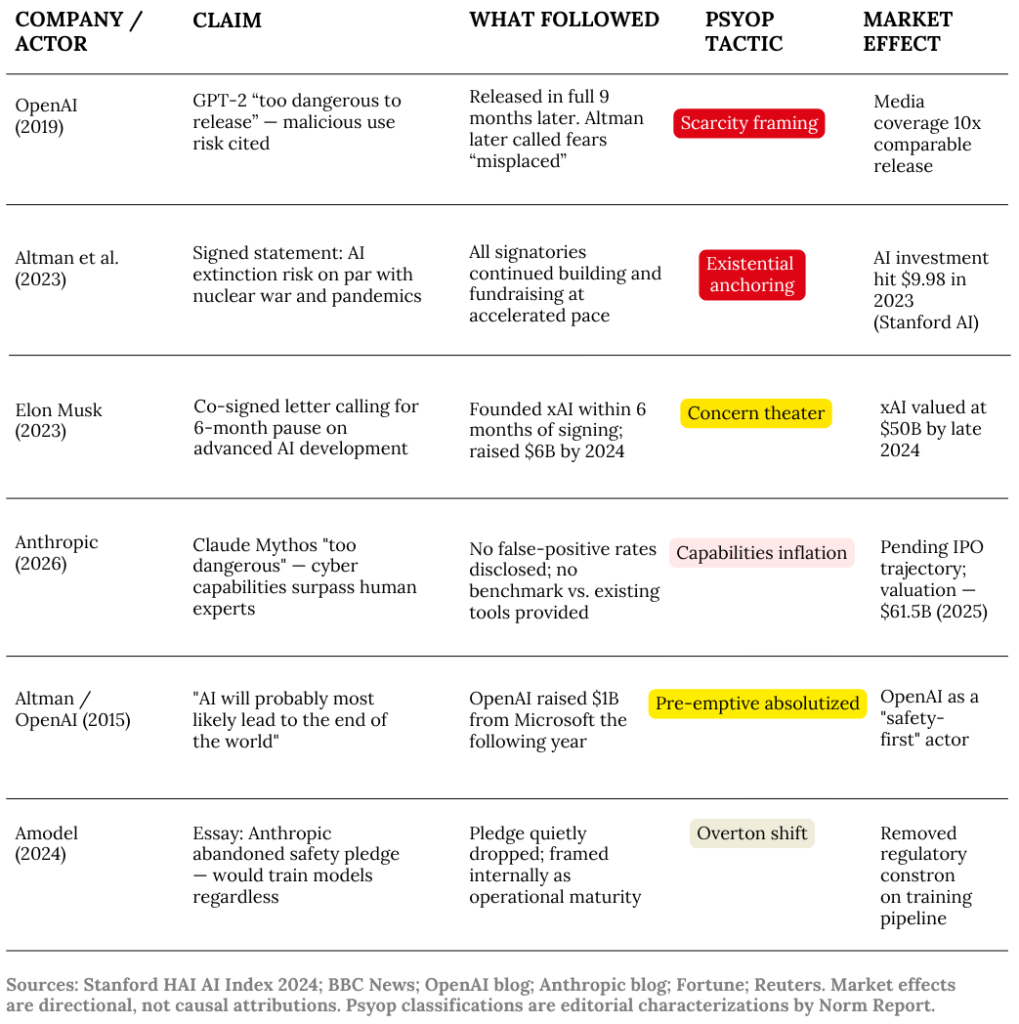
Look at the table above. Every major AI lab has run some version of this play. OpenAI declared GPT-2 too dangerous in 2019 and released it nine months later. Sam Altman signed an extinction-risk statement in 2023 while accelerating OpenAI’s push toward a for-profit structure. Elon Musk co-signed a letter calling for a six-month AI pause — and launched xAI inside that same six-month window. Anthropic abandoned its flagship safety pledge, the one that said it would never train a model it couldn’t guarantee was safe, then reframed the move as operational maturity.
The data underneath this isn’t soft. According to Stanford’s Human-Centered AI Institute, global AI private investment reached $91.9 billion in 2023 — the same year industry leaders were publicly comparing AI risk to nuclear war. Fear and funding moved in the same direction. That’s not a coincidence. That’s a correlation worth examining in any board-level risk assessment.
The real harms are getting drowned out
Here’s what the psyop is designed to suppress. While executives debate whether Claude Mythos could theoretically destabilize national infrastructure, the demonstrable harms are compounding in real time.
Gas-powered data centers are projected to emit greenhouse gases at a national scale. AI-driven misdiagnosis rates in healthcare remain poorly disclosed. Research is accumulating on AI’s links to psychosis and suicide in vulnerable users. A growing body of peer-reviewed work suggests possible connections between heavy AI use and cognitive decline. Deepfakes have crossed the detection threshold, the BBC reporter couldn’t convince her own family she wasn’t one.
Emily Bender, computational linguistics professor at the University of Washington, calls the apocalypse framing a misdirection: “Look over here, never mind the environmental destruction and the labour exploitation and all these systems we’re destroying in society.” She’s right. And executives who govern organizations that are increasingly dependent on AI infrastructure should be asking why none of these near-term, measurable risks generate the same volume of press releases as the speculative ones.
What C-suite leaders should actually take from this
First: the cybersecurity claims around Mythos are contested. Heidy Khlaaf, chief AI scientist at the AI Now Institute and a career expert in exactly the kind of code-analysis tools Anthropic claims to have surpassed, flagged the absence of false-positive rates, the most basic measure of a security tool’s real-world utility. Anthropic didn’t provide them. That’s not an oversight. Tools that can’t be benchmarked can’t be procured responsibly. If your security team is evaluating AI-driven vulnerability detection, demand standard metrics.
Second: the regulatory narrative embedded in all of this is worth reverse-engineering. The implicit argument is always the same, these systems are so powerful that only the companies building them can govern them. This framing benefits exactly one constituency. Shannon Vallor again: “Every technology, save this one, even nuclear, even biological weapons, in no other case have we allowed these narratives to make us think these are forces beyond human control.” Nuclear technology is governed. Bioweapons are governed. AI governance is not a technical impossibility. It’s a political choice that certain actors have financial incentives to delay.
Third: watch the incentive structure, not the press release. Google dropped its red lines on AI weapons. OpenAI fought to shed its non-profit status. Anthropic dropped its safety pledge. These are not aberrations, they are the incentive structure expressing itself. “If you want to understand how an organisation, particularly a corporation, is going to behave, look at what its incentives are,” Vallor told the BBC. That’s as good a due diligence framework as any.
The tell
The deepest tell in all of this is the dual narrative that runs simultaneously in the same mouths. Altman’s 2024 essay promised that AI will fix the climate, colonize space, and unlock all of physics. Amodei wrote about “a country of geniuses in a datacenter.” Utopia and apocalypse, back to back, from the same sources.
Vallor’s read on this is precise: in either frame, demons or messiahs, the scale is “far too grand and mythic for things like regulation, or governance or court law to feel like you can get purchase on it.” That’s the goal. Make the stakes so cosmic that normal governance instruments feel inadequate. Then fill the vacuum yourself.
This isn’t paranoia. It’s pattern recognition. The Metaverse was supposed to replace reality. Bitcoin was going to supersede currency. Social media was going to save democracy. Some of those bets still might land. Most didn’t. The question for any executive evaluating AI claims in 2026 is the same one it’s always been: who benefits from your believing this, and what are they selling?
In this case, the answer is not mysterious. They built it. They’re scared of it. They’re selling it anyway. The only question is whether you’re buying the fear along with the product.
The AI Fear Marketing Playbook: A Pattern Audit
Key incidents of doom-framing by major AI labs. 2019 – 2026, with psyop classification: