
For the past three years, executives have stood at podiums, sat on panels, and sent company-wide emails with some version of the same message: AI is a tool, it will empower your work, the future is bright. What they haven’t said, what new data now forces into the open — is that they’re just as scared as you are.
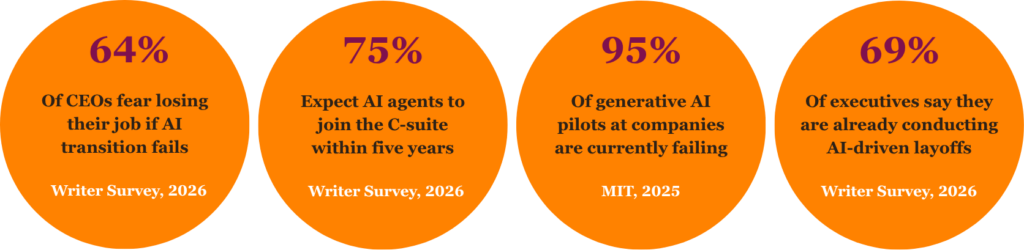
A survey of 2,400 knowledge workers and executives by AI platform Writer found that 61% of enterprise tech leaders fear losing their job if they fail to lead their organization through the AI transition. Nearly half said the risk of losing their job in the next year specifically is something they actively think about. The people giving the reassuring speeches are rehearsing them in front of a mirror, hoping to convince themselves too.
The people who spent three years telling employees not to panic are now quietly panicking.
By The Numbers:
The cognitive dissonance is breathtaking. Ninety-seven percent of executives in the same survey say AI has been beneficial to their organization. Yet only 29% report meaningful ROI from generative AI, and nearly half describe adoption at their company as “a massive disappointment.” They’re selling a story they can’t yet prove, to boards demanding returns on enormous infrastructure bets, while privately admitting that 58% of their fellow C-suite leaders don’t have the foundational knowledge to make sound AI strategy decisions.
Let that sink in. The majority of people setting enterprise AI strategy may not actually understand what they’re deploying.
“75% of executives admit their company’s AI strategy is ‘more for show’ than actual internal guidance.” – Writer/Workplace Intelligence Survey
The pressure is cascading down hierarchies in real time. More than half of surveyed executives said AI adoption has created “power struggles and disruption” at their organizations. Sixty-nine percent are already conducting layoffs because of AI. The workforce is splitting into two camps, AI super-users pulling ahead, and resisters falling behind, and leadership is doing little to bridge the gap, because leadership hasn’t figured out which camp it’s in either.
Meanwhile, the macro data provides zero comfort. The IMF estimates that 40% of jobs globally face meaningful AI exposure, a figure that climbs to 60% in advanced economies. McKinsey finds that current AI tools could technically automate 57% of U.S. work hours. The World Economic Forum’s 2025 Future of Jobs report found that 41% of employers worldwide plan to cut portions of their workforce within five years specifically because of AI. Goldman Sachs put a number on the global ceiling: up to 300 million full-time job equivalents at risk from automation. These are not fringe projections. These are mainstream institutional forecasts.What’s remarkable about the Writer survey is that it strips away the corporate euphemisms. Executives aren’t just nervous about their companies. They’re nervous about themselves, their relevance, their skills, their shelf life. Half said they feel their own skills are becoming obsolete. Three-quarters expect AI agents to be sitting on their executive committees within five years. They are not describing a distant transformation. They are describing their own replacement timeline.
Executives aren’t just worried about their companies. They’re worried about their own shelf life.
AI & The C-Suite
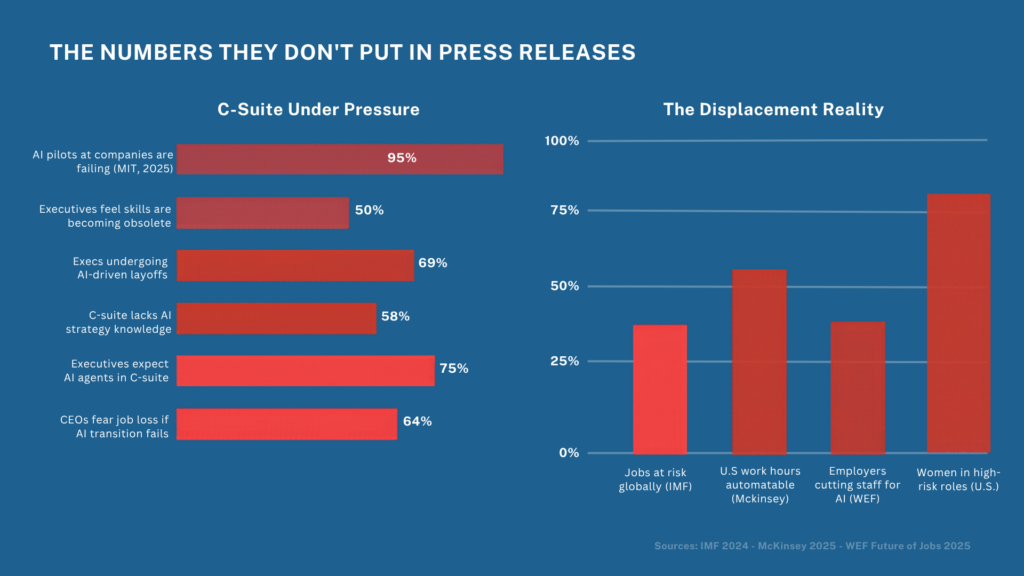
There’s a grim irony at the heart of this. The executives most visibly committed to AI adoption, the ones threatening their teams, announcing layoffs, and chasing ROI, are doing so partly out of self-preservation. If they don’t lead boldly, they lose their seat. If they lead badly, they lose it faster. The incentive structure rewards the appearance of progress over the substance of it, which is exactly why 75% of companies apparently have AI strategies designed to impress boards rather than actually guide operations.
The organizations that thread this needle will be the ones that treat AI strategy as a talent decision rather than a technology purchase. That means asking what institutional knowledge, judgment, and expertise can be systematized, and then building those capabilities into workflows deliberately. It means closing the super-user gap by making AI literacy a baseline expectation, not a competitive differentiator. And it means senior leaders being honest about what they don’t know, at a moment when admitting ignorance feels professionally fatal.
The executives who survive this won’t be the ones who talked the loudest about transformation. They’ll be the ones who quietly built something real, while everyone else was busy making AI strategy decks.