In the annals of geopolitical turning points, most are obvious only in retrospect. The shot at Sarajevo. The fall of the Berlin Wall. The detonation of the first Soviet nuclear device. They appear, at first, to be discrete events – a policy change, a procedural error, a technical milestone. Their true significance only becomes visible when viewed through the lens of what follows.
What happened at NeurIPS this week may be one of those moments.
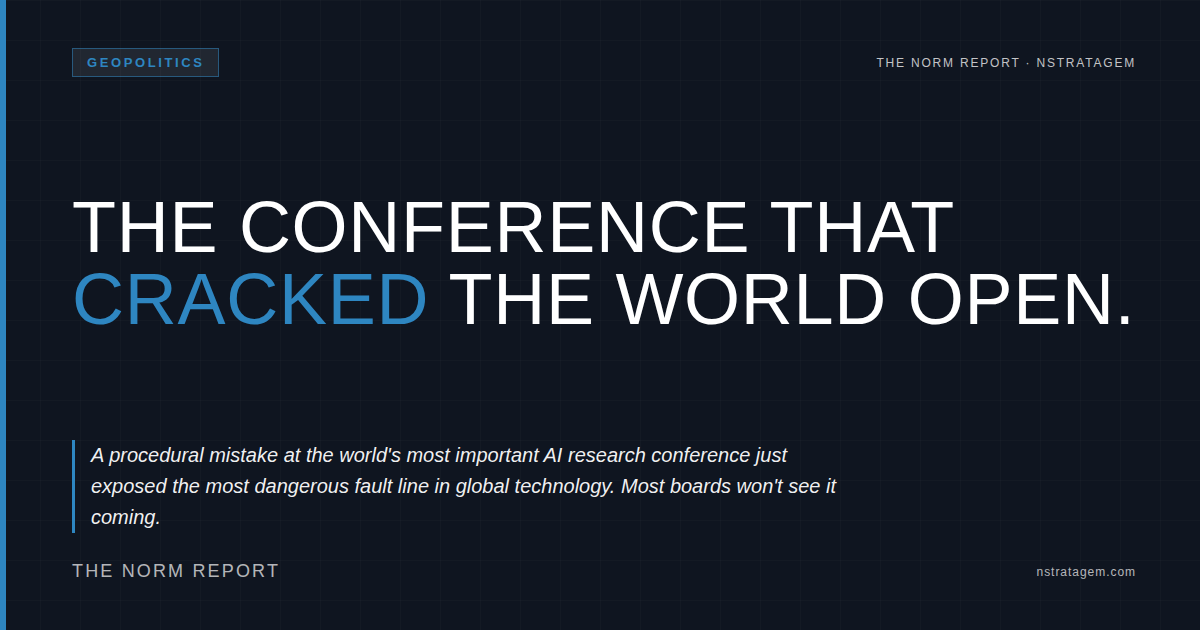
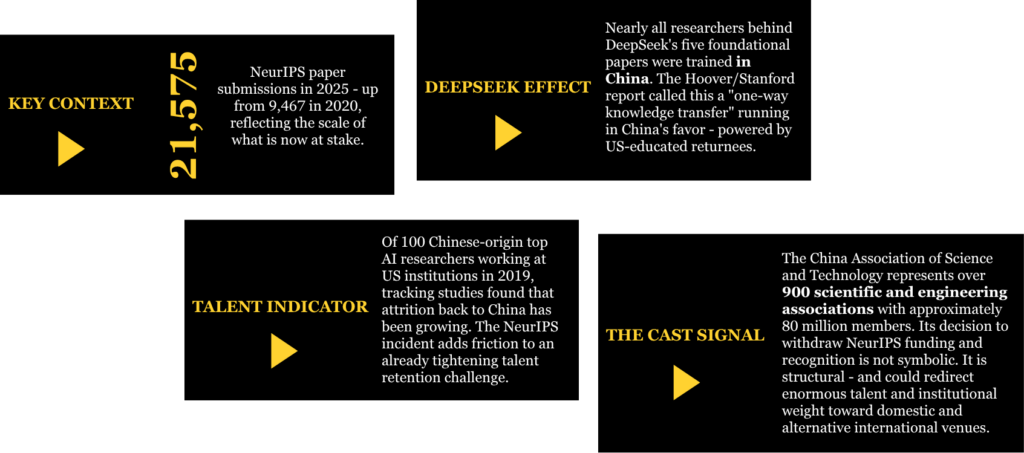
The Conference on Neural Information Processing Systems, the world’s most prestigious annual gathering of AI researchers, with over 21,000 paper submissions in 2025 alone, stumbled into a geopolitical minefield when it published updated participation rules that would have barred researchers affiliated with Chinese technology companies, including Tencent and Huawei, from the conference’s peer review and publishing services. The rules, which linked to a US government sanctions database that covers a far broader set of entities than NeurIPS is legally required to observe, were quickly reversed after a storm of protest from the global scientific community.
The organizers called it a miscommunication with their legal team. That explanation is probably accurate. But it almost doesn’t matter.
Because the damage was done in the reaction, not the rule itself. China’s influential government-affiliated scientific body, the China Association of Science and Technology (CAST), announced it would withdraw funding for Chinese scholars attending NeurIPS 2026 and would redirect those resources to domestic and international conferences that “respect the rights of Chinese scholars.” CAST also declared it would no longer count NeurIPS publications as academic achievements when evaluating research funding, an extraordinary measure that, if sustained, could begin to redirect China’s formidable AI research community away from the world’s most important AI forum.
“At some level now it is going to be hard to keep basic AI research out of the political picture.” – Paul Triolo, DGA-Albright Stonebridge
For boards and executives managing AI strategy, this is not a story about academic politics. It is a story about the fracturing of the global knowledge commons that has underpinned the AI revolution, and the strategic consequences that fracture will produce for organizations operating across borders.
THE NUMBERS YOU NEED TO UNDERSTAND
To grasp the significance of this incident, you need to understand what China now represents in global AI research. The picture is more dramatic than most Western boardrooms appreciate.
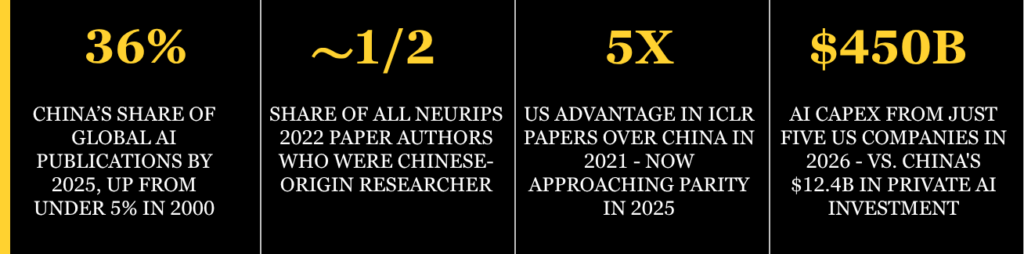
China now produces approximately 36% of global AI publications, up from under 5% in 2000, according to a 2025 analysis drawing on OpenAlex data. The US and EU, which together commanded over 57% of global AI publications at the turn of the century, now account for less than 25% combined. This is not a story about volume alone. China has also recently led in high-impact publications, a finding that, as researchers note, “challenges the general assumption that Western powers retain dominance in high-impact AI scholarship.”
At ICLR, one of AI’s three most prestigious conferences, the trajectory is stark: China was outnumbered 5-to-1 by American papers in 2021. By 2025, it had reached near parity.Analysts tracking the data now predict that by 2026, China will produce more papers at ICLR than the United States, the first time any country has surpassed America at a top-tier AI conference.
NeurIPS 2022 data from Carnegie Endowment research found that Chinese-origin researchers made up nearly half of all sampled paper authors, with Chinese institutions holding a 28% share, still short of the US at 42%, but having more than doubled from earlier measurements. The three best papers at NeurIPS 2025 were led by researchers from Qwen, Princeton, and the University of Washington. One of those three institutions is Chinese.
THE DECOUPLING FALLACY – AND WHY BOARDS KEEP BELIEVING IT
Washington has operated under a coherent-sounding thesis for several years now: that restricting China’s access to advanced chips, limiting technology exports, and discouraging academic collaboration can preserve American AI supremacy. The logic is seductive. If you starve a competitor of the inputs, compute, talent, knowledge, you slow the competition.
The NeurIPS incident exposes precisely why this thesis is fragile.
The first problem is that decoupling is asymmetric. When Chinese researchers are excluded from American conferences, they do not disappear. They consolidate around domestic institutions, conferences, and talent pipelines. CAST’s decision to redirect funding toward domestic research venues is not merely a protest, it is an acceleration of exactly the self-sufficiency trajectory that American policymakers claim to fear. Exclusion does not weaken a rival’s research ecosystem. It forces it to become more independent.
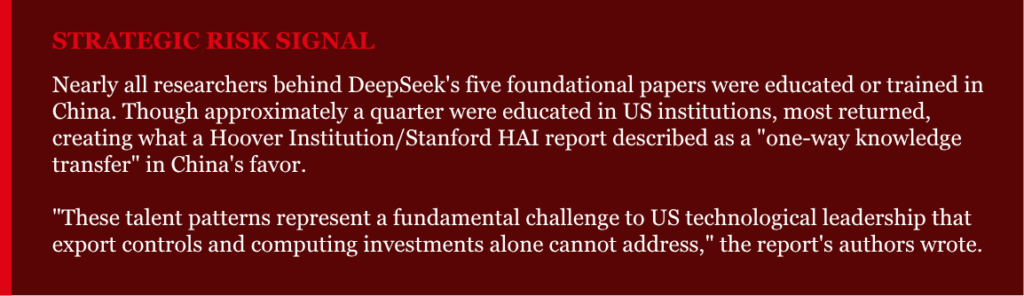
The second problem is the talent pipeline. For decades, the United States has benefited enormously from educating the world’s top AI researchers, including Chinese-origin researchers, and retaining a significant proportion of them in American universities and technology companies. That pipeline is under pressure. The NeurIPS episode will not help. When Chinese researchers observe their academic community being treated as a security risk at the world’s premier AI conference, the signal being sent is unambiguous: you are not fully welcome here. Some will decide the signal is clear enough.
The third problem is the innovation commons. AI research does not advance through isolated national efforts. It advances through citation, collaboration, replication, and competitive response to published work. The foundational breakthroughs, transformers, attention mechanisms, reinforcement learning from human feedback, were all built on cumulative global scholarship. Fracture the commons and you slow everyone, not just the competitor you are trying to contain.
THE INVESTMENT GAP THAT TELLS HALF THE STORY
Capital is where the US advantage remains overwhelming, and where the analysis gets more complicated than the headline numbers suggest.
American private investment in AI reached $285.9 billion in 2025, more than 23 times China’s $12.4 billion, according to Stanford’s AI Index. The US funded 1,953 new AI companies last year, more than ten times any other country. Just five US companies, Meta, Alphabet, Microsoft, Amazon, and Oracle, are expected to spend more than $450 billion in AI-specific capital expenditure in 2026 alone. That number exceeds the entire Apollo program in inflation-adjusted terms.
These are extraordinary advantages. But they are advantages in commercialization, infrastructure, and model development, not necessarily in fundamental research, which is where the NeurIPS story lives.
China’s response to capital constraints has been instructive. Rather than conceding the competition, it has optimized around it. DeepSeek’s breakthrough demonstrated that algorithmic efficiency and architectural innovation can substantially reduce the compute requirements that export controls were designed to leverage. Chinese AI models currently lag US rivals by approximately three to six months on benchmark performance, but that gap is narrowing. Some domestic Chinese founders now predict their country will become the world’s leading AI power by 2027.
Meanwhile, China has quietly invested in electricity infrastructure at a pace that gives it substantial headroom for AI compute growth. The country adds more electricity demand each year than Germany’s entire annual consumption, and its reserve margin has never dropped below 80%, approximately twice the capacity needed to support AI infrastructure growth.
The strategic picture, then, is not of an American juggernaut and a Chinese also-ran. It is of two different kinds of advantage in active competition, with the research commons that has historically benefited both now under political pressure.
WHAT THIS MEANS FOR YOUR ORGANIZATION
Boards and CEOs absorbing this analysis face a more complex strategic environment than simple “US vs. China” framing suggests. Here is what the NeurIPS incident concretely implies for organizational decision-making.
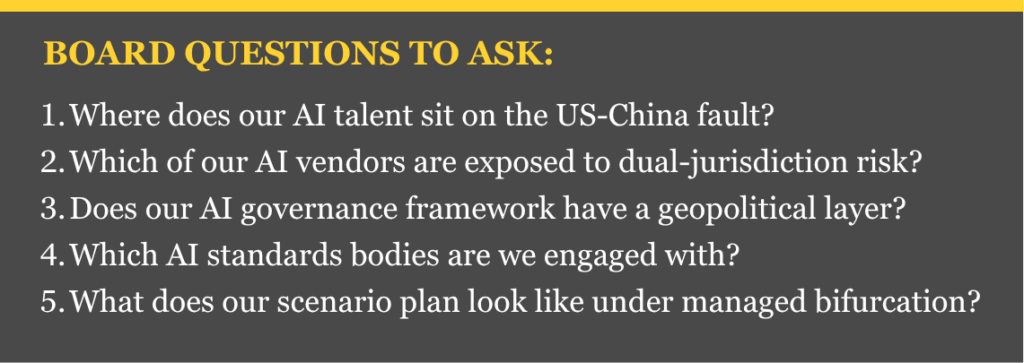
First, your AI talent strategy has geopolitical exposure you may not have priced in. If your AI team includes researchers of Chinese origin, or researchers who have studied, collaborated with, or published alongside Chinese institutions, the evolving political environment in Washington will create friction. Visa policy, research collaboration restrictions, and the general chilling effect of “China risk” on academic partnerships are already shaping talent mobility. Organizations that fail to model this exposure in their workforce planning will be surprised when it manifests.
Second, the AI vendor and platform landscape is bifurcating. Organizations with significant operations in China are already navigating a world where the AI tools approved for use in Western markets are different from those available or optimized for Chinese deployment. That divergence will accelerate. Supply chain decisions made today about AI infrastructure, cloud providers, foundation model vendors, data pipeline architecture, carry embedded geopolitical assumptions that may constrain your options in five years.
Third, the regulatory and standards environment is fragmenting. When CAST declared it would no longer count NeurIPS publications as academic achievements, it was not merely registering protest. It was signaling an intent to build a parallel credentialing and standards ecosystem. AI technical standards, for safety evaluation, model documentation, benchmark methodologies, will increasingly be contested between Western and Chinese-aligned frameworks. Organizations operating globally will face compliance demands from incompatible regimes.
The competitive advantage in this environment will not belong to organizations that pick a side fastest. It will belong to those that can navigate both systems with the greatest fluency and least friction.
Fourth, your board’s AI governance framework almost certainly has no geopolitical layer.Most AI risk frameworks were designed to address technical failure, regulatory compliance, bias, and cybersecurity. Very few were designed to address the scenario where the foundational research ecosystem your AI products depend on fractures along national security lines, where your AI talent pool becomes politically sensitive, or where the AI vendors you depend on are caught between competing governmental demands. This is now a material board-level risk.
THE HARDER QUESTION – AND THE HONEST ANSWER
The deeper question the NeurIPS incident poses is one that no political framework in Washington or Beijing has honestly answered: Is it actually possible to decouple AI research without destroying the thing that makes AI valuable?
The honest answer, from a geopolitical science perspective, is: not fully, not quickly, and not without significant cost to both sides.
The transformer architecture that powers virtually every large language model in production today was published in an open paper by Google researchers in 2017. It was immediately built upon by researchers in China, the US, Europe, and beyond. The reinforcement learning from human feedback technique that made ChatGPT possible was developed through a chain of academic work that crossed national boundaries dozens of times. The NeurIPS 2024 best paper was from Tsinghua and ByteDance. Stanford and Berkeley are foundational to Chinese AI. The knowledge is already integrated. The researchers are already entangled.
Attempts to retroactively decouple this system will produce two things with high confidence: they will slow the global pace of foundational AI progress, and they will accelerate China’s investment in exactly the domestic capabilities and international relationships, with the Global South, with academic institutions in non-aligned countries, with its own conference ecosystem, that the decoupling strategy is ostensibly designed to prevent.
This is not an argument against national security vigilance in AI. There are genuine risks in unrestricted collaboration in dual-use AI research, and no serious analyst disputes that some boundaries are appropriate. The question is whether a blunt instrument, applied carelessly, as NeurIPS’s legal team appears to have done, produces more security or less.
Paul Triolo of DGA-Albright Stonebridge put it precisely: attracting Chinese researchers to NeurIPS is beneficial to US interests. The incident may have damaged that interest. Whether the damage is temporary or structural depends on decisions being made right now, in CAST offices, in Washington policy rooms, and in the offices of AI conference organizers who have suddenly discovered that a footnote in a legal handbook can become an international incident.
THE BOARD IMPERATIVE
For executives and boards, the strategic posture that this environment demands is neither reflexive nationalism nor naive globalism. It is informed navigation.
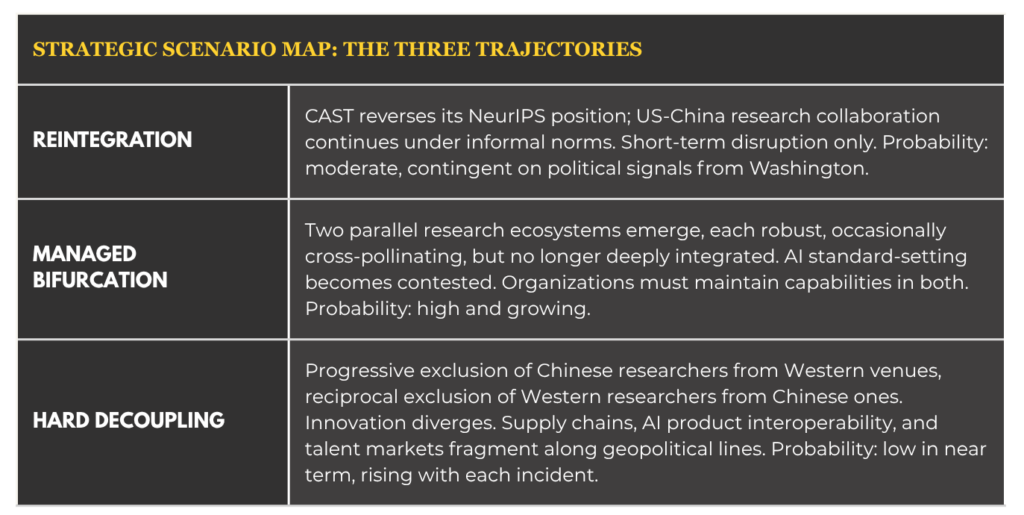
That means building explicit geopolitical risk into AI strategy reviews, understanding where your AI capabilities, talent, and infrastructure sit on the US-China fault line, and what your exposure looks like under each of the three scenarios outlined above.
It means understanding the difference between compliance risk and strategic risk. You can be fully compliant with every applicable law and still find yourself on the wrong side of a bifurcated AI ecosystem five years from now.
It means having a perspective on AI standards, not just regulatory compliance, but the emerging contest over what AI benchmarks, safety standards, and evaluation frameworks will govern global deployment. Organizations that engage in that process will have more options than those that wait to be governed by whatever framework emerges.
And it means resisting the temptation to treat this as someone else’s problem. The NeurIPS incident looked like a procedural error at an academic conference. It is, in fact, a preview of the governance challenges that will define the next decade of AI competition.
The organizations that thrive in that environment will not be those that move fastest. They will be those that understand, with precision and without illusion, the geopolitical architecture within which AI is now being built.
A procedural mistake in a conference handbook just made that architecture visible. The question now is who is paying attention.
ANALYSIS BASED ON PUBLICLY AVAILABLE DATA INCLUDING STANFORD HAI AI INDEX 2026, CARNEGIE ENDOWMENT RESEARCH, HOOVER INSTITUTION/STANFORD HAI TALENT ANALYSIS, AND CSIS REPORTING. ALL FIGURES CITED REFLECT CONDITIONS AS OF APRIL 2026. THIS REPRESENTS EDITORIAL ANALYSIS AND DOES NOT CONSTITUTE LEGAL, INVESTMENT, OR COMPLIANCE ADVICE.