In Chennai, a 25-year-old engineering graduate named Rani N. spends her day folding the same towel, ninety times, in a fake apartment built for one purpose: to teach a humanoid robot how a human hand moves. A few kilometres away, a housewife named Nagireddy Sriramyachandra straps a smartphone to her forehead and films herself slicing mangoes, earning roughly 250 rupees — about $2.60 — for an hour of footage that will, in time, instruct a machine that may not need her again.
This is not a story about robots. It is a story about a transaction that almost no leadership team has priced correctly: millions of workers worldwide are being paid a wage to generate the asset that retires the wage. The humanoid robotics sector is scaling at a compound rate north of 50% a year, and at the foundation of that growth sits an army of human demonstrators whose labour is the raw material — and whose displacement is the eventual product. For boards and executive committees, this is no longer a tech-sector curiosity. It is a live case study in three failures that recur whenever transformative technology meets a labour market: the principal-agent trap, Goodhart’s Law applied to human effort, and the Collingridge Dilemma of governing a technology before its consequences are visible. Leaders who treat this as someone else’s supply-chain issue will find it on their own balance sheet within three years — as a talent, reputation, or regulatory cost.
The Proof Point: A Smartphone, a Kitchen, and a Business Model
The mechanism is almost elegantly simple. Companies building humanoid robots — backed by some of the largest technology balance sheets on the planet — need vast quantities of “egocentric data”: first-person video of ordinary humans performing ordinary tasks. Folding laundry. Making coffee. Wiping a counter. Slicing fruit. The footage trains the robot’s perception and motor-control models to imitate human movement with enough fidelity to operate in a home or warehouse.
India has become one of the centres of gravity for this work, for the same reason it became a centre of gravity for call centres and back-office processing two decades ago: a large, English-capable, technically literate workforce willing to do repetitive digital labour at a fraction of the cost in higher-wage markets. At studios like the one operated by Objectways, workers film themselves in furnished mock apartments — bedroom, kitchen, living room — performing the same domestic task for roughly four minutes at a time, around ninety times a day. When the backdrop becomes too familiar to the algorithm, the wallpaper is changed and the cycle continues.
The workers are, by most accounts, willing participants. The pay, while low by Western standards, is steady and the work is indoors and physically light compared with alternatives. What is largely absent from the transaction is a clear, board-level conversation about what is actually being purchased: not a video, but a behavioural blueprint — and the right to deploy that blueprint at scale, indefinitely, without the original demonstrator’s further involvement or ongoing compensation.
India’s own government think tank, NITI Aayog, has flagged the broader pattern: that public debate about AI and jobs remains fixated on white-collar, knowledge-worker disruption, while a much larger and faster-moving displacement is building in physical, blue-collar, and domestic labour — the very category of work now being filmed, catalogued, and optimised out of existence.
The Economics of Self-Replacement
Strip away the human-interest framing and what remains is a textbook case of asymmetric value capture. The worker is compensated for the marginal cost of their time. The buyer is acquiring the marginal value of a reusable training asset — one that compounds across every robot unit the model is ultimately deployed in, for years, at a market projected to grow from roughly $6 billion in 2026 to well over $150 billion by the early 2030s.
Figure 1: The Wage-Value Gap in the Embodied AI Supply Chain
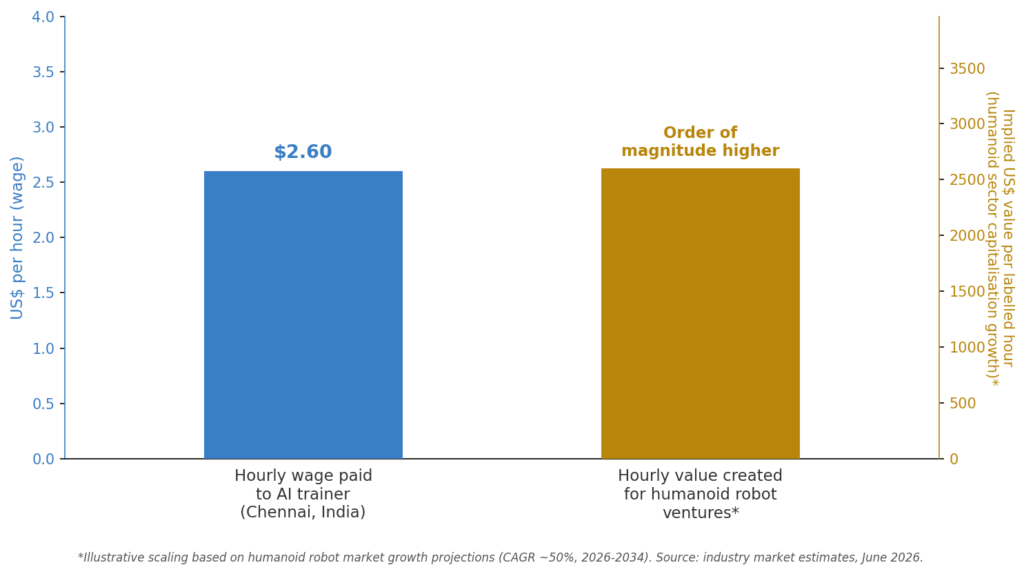
This is not, in itself, an indictment of the workers or even of the companies — data acquisition has always been priced below the value of the model it ultimately trains. What changes the calculus here is the directness of the substitution. A data-entry worker training a document-classification model is, at several removes, contributing to automation of some category of work. A domestic worker filming herself folding towels is training the literal, physical successor to her own task — and in many cases, to her own livelihood, given how thin the line is between “household chores” and the broader category of paid domestic and service labour that employs hundreds of millions of people globally.
Economists have a name for the broader phenomenon: a classic case of mispriced externalities, where the cost of the transition — retraining, income disruption, social safety nets — is not carried by the parties who capture the upside. What is unusual is the compression of time and proximity. The externality here is not abstract or generational. It is the same person, the same skillset, on a timeline measured in months, not decades.
For leaders, the lesson is not “stop building robots.” It is that the unit economics of any AI training pipeline that uses human behavioural data should be evaluated with the same rigour applied to any other capital allocation decision — including the downstream liability of having effectively purchased the obsolescence of a workforce segment without budgeting for its consequences.
The Self-Replacement Quadrant: A Principal-Agent Problem Hiding in Plain Sight
Principal-agent theory exists to describe situations where one party (the principal) depends on another (the agent) to act on their behalf, but the two have misaligned incentives and unequal information. Usually, the framework is applied to executives and shareholders, or to contractors and clients. Here, it applies — uncomfortably — to the relationship between an employer and a worker who is being asked, unknowingly or semi-knowingly, to act against their own long-term interest.
Figure 2: The Self-Replacement Quadrant

Plotting this relationship across two axes — how transparent the employer is about the end use of the data, and how aware the worker is of the substitution risk — produces four distinct postures, and only one of them is defensible at board level.
Most of the current market sits in the upper-left and lower-left quadrants: low transparency, and either low or high worker awareness. In the “Disguised Displacement” quadrant, workers genuinely do not know — or are not told in any meaningful way — that their movements are training a commercial replacement for categories of labour, including, potentially, their own. In “Exploitative Drift,” workers increasingly suspect the purpose, word spreads through informal networks, and trust erodes faster than any HR or PR function can manage it, typically surfacing first as unexplained attrition and only later as a media story.
The upper-right quadrant — “Informed Bargain” — is where most well-intentioned companies believe they operate: disclosure exists, contracts are signed, terms are clear. But disclosure of purpose is not the same as comprehension of pace. Few workers asked to fold a towel ninety times a day fully grasp that the underlying model’s capability curve is compounding at 50% annually, and that the gap between “this helps a robot learn” and “this robot can now do my job” may be a matter of two or three years rather than a generation.
The lower-right quadrant — “Aligned Transition” — is the only governance posture that holds up under scrutiny: full transparency about end use, combined with workers who understand the substitution timeline and are compensated, contracted, and reskilled accordingly. Vanishingly few organisations in this supply chain currently operate here. That is the opportunity. The first major AI labs or robotics firms to move credibly into this quadrant will not just reduce regulatory and reputational exposure — they will build a recruitment and brand advantage in a labour market that is rapidly becoming aware of what it is being asked to do.
Goodhart’s Law and the Productivity Mirage
Goodhart’s Law states, in its most useful form, that when a measure becomes a target, it ceases to be a good measure. Applied to call centres, this produced the well-documented phenomenon of agents optimising for “average handle time” at the expense of actually resolving customer problems. Applied here, it produces something more unsettling.
The metric being optimised across this industry is hours of usable demonstration footage, often paid per task or per video. Workers — rational economic actors — respond to that incentive by maximising volume: ninety repetitions of the same action, performed as cleanly and consistently as possible, because consistency and volume are what the model needs and what gets paid. The worker is, in effect, training the model on the most automatable version of their own behaviour — stripped of the variability, judgment calls, and contextual adaptation that make human labour valuable in the first place.
This matters because it accelerates the substitution timeline beyond what “natural” human behavioural data would produce. A workforce paid to perform tasks in the most legible, repeatable, machine-friendly way possible is — by construction — making itself easier to replace than it would be if simply observed going about its normal, messy, adaptive working life. The target (clean training data) has changed the underlying reality (human work) in a direction that serves the model, not the worker — and not necessarily the long-term interest of the companies either, because a robot trained on sanitised, repetitive demonstrations may itself struggle with the variability of real homes and real customers, a problem that tends to surface only after deployment, when it is far more expensive to fix.
The Collingridge Gap: Governing a Technology Before the Evidence Arrives
David Collingridge’s classic dilemma is this: early in a technology’s life, when it would be easiest and cheapest to shape its trajectory, we don’t yet have enough information to know what needs shaping. By the time the consequences are clear, the technology is too embedded — economically, socially, institutionally — to change course without enormous cost.
Figure 3: The Widening Gap – Robot Capability vs. Workforce Reskilling
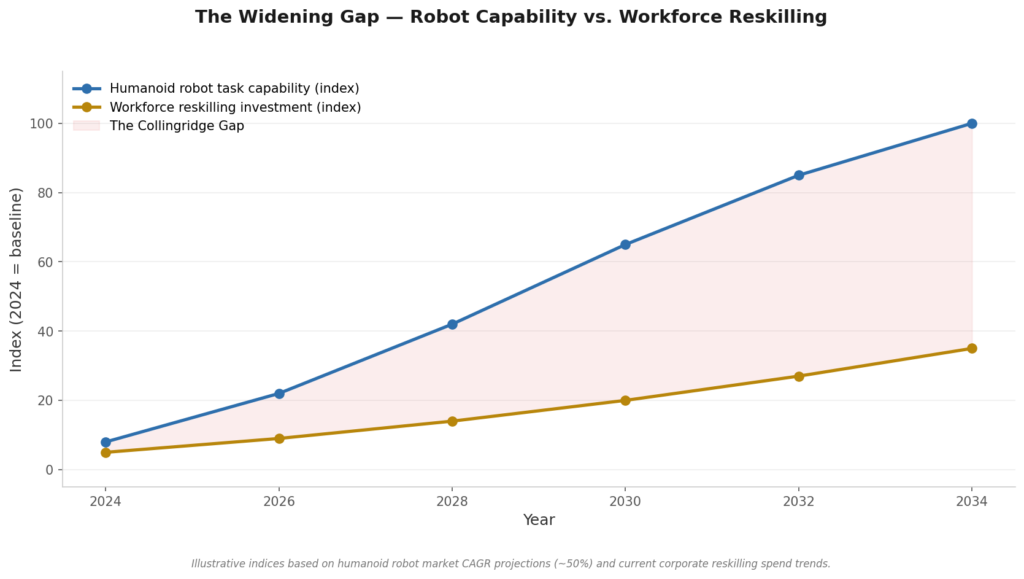
Humanoid robotics is in the textbook window of this dilemma right now, and the gap is widening visibly. Capability curves for embodied AI are compounding at rates that mirror or exceed the early trajectory of large language models — themselves a cautionary tale in how quickly “interesting research demo” became “structural change to entire professions.” Meanwhile, corporate and public investment in reskilling pathways for the categories of work most exposed — domestic labour, food preparation, warehouse and light-manufacturing tasks, basic caregiving support — has moved at the pace institutions usually move: incrementally, reactively, and several years behind the technology it is meant to address.
The workers currently generating the training data are, in most cases, not the same individuals who will lose domestic, food-service, or logistics jobs to the robots those models eventually power — but they are drawn from the same labour pool, the same skill bands, and increasingly the same households. The Collingridge Gap is not an abstraction here; it is the literal distance between the moment a worker films themselves folding a towel for $2.60 an hour and the moment a robot trained partly on that footage is deployed into a hotel laundry, a hospital ward, or a household three streets away.
Closing this gap is not primarily a technology problem. It is a governance problem — and it is one that sits, whether boards have recognised it yet or not, squarely within the remit of risk committees, ESG frameworks, and long-term workforce strategy.
The Leadership Readiness Scorecard
For executives whose organisations sit anywhere in this value chain — as buyers of AI training data, as investors in robotics ventures, as employers of the workforce segments most exposed to humanoid substitution, or simply as companies that will need to manage the public narrative when this story moves from a niche feature to a mainstream political issue — five questions separate organisations that are prepared from those that will be caught flat-footed.
The Embodied AI Leadership Readiness Scorecard
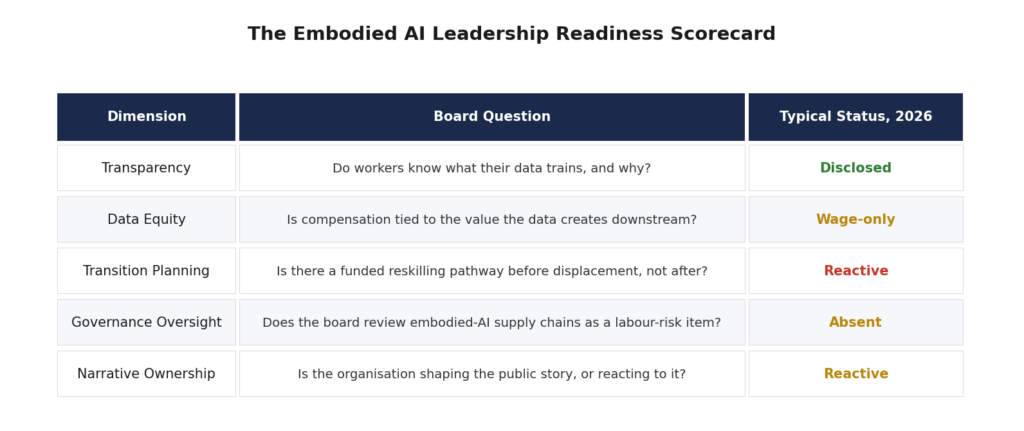
The pattern across almost every organisation currently operating in this space is the same: transparency exists in the contractual sense but not the comprehension sense; compensation is wage-only with no link to the downstream value the data creates; transition planning is reactive rather than funded in advance; governance oversight of embodied-AI labour supply chains is largely absent from board agendas; and the public narrative — as this article itself demonstrates — is currently being written by journalists and NGOs, not by the companies involved.
None of these gaps are difficult to close in isolation. What is difficult is recognising, before the regulatory and reputational pressure arrives, that they need to be closed at all. The organisations that move first into the “Aligned Transition” quadrant — disclosure, equitable compensation structures, funded reskilling, board-level oversight, and proactive narrative ownership — will be the ones telling this story on their own terms in 2028, rather than responding to it.
The Takeaway for Senior Leaders
The image of a woman with a smartphone strapped to her forehead, slicing mangoes for $2.60 an hour, is striking because it makes visible something that is usually hidden: the moment at which human labour becomes the input to its own obsolescence. But the underlying dynamic — workers and organisations unknowingly accelerating their own disruption because the incentives in front of them are misaligned with the consequences down the line — is not unique to domestic robotics. It is present in every industry currently feeding proprietary data, workflows, and institutional knowledge into AI systems without a clear view of where that data leads.
The discipline required here is not technological. It is the same discipline that distinguishes organisations that survive structural change from those that are surprised by it: the willingness to look honestly at where today’s incentives are pointing, three to five years out, and to govern accordingly — before the gap becomes the headline.