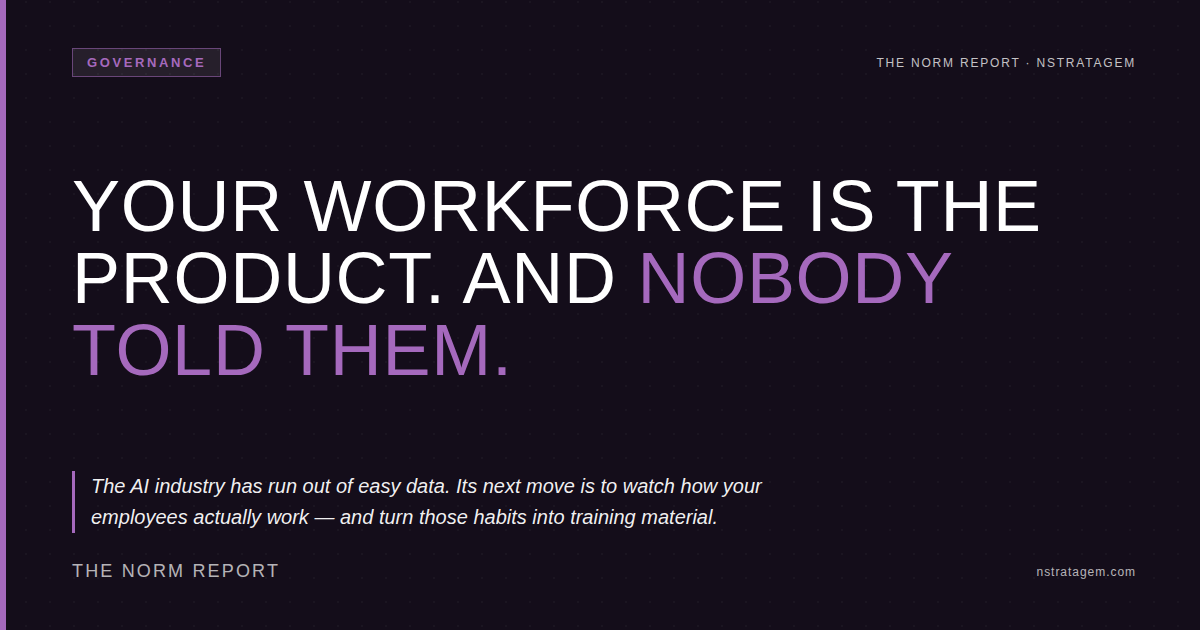
For years, AI was trained on the internet, blogs, books, code repositories, social media, the accumulated digital exhaust of human civilization. That supply chain is now under severe pressure. Lawsuits are mounting. Licensing demands are escalating. Privacy regulators are circling. The era of free public data is ending.
So the industry has found a new source: your people.
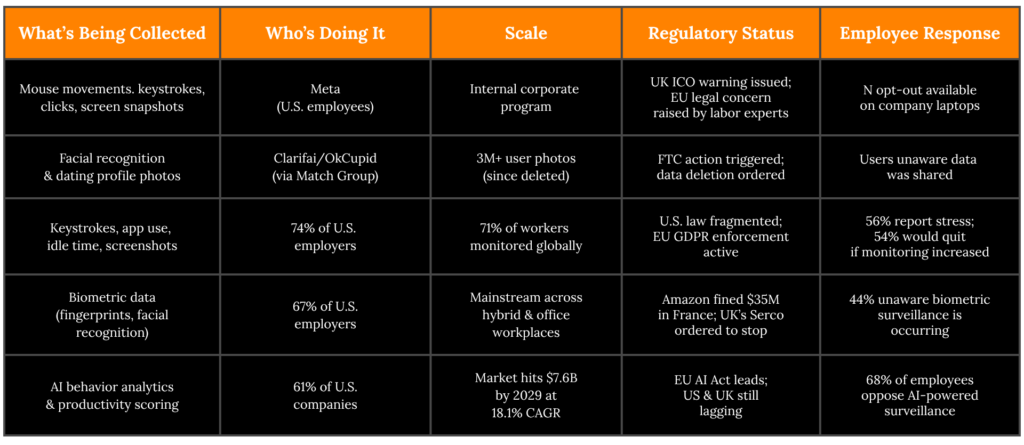
Reuters recently reported that Meta is installing software on U.S. employee work computers to capture mouse movements, keystrokes, clicks, and screen snapshots. The stated purpose is to train AI systems that understand how people move through software and complete office tasks, not to evaluate performance, Meta said, but purely for model development. Whether or not you accept that framing, the strategic logic is unassailable. Behavioral data is hard to fake. It shows how enterprise software is actually used, where workflows break down, and how experienced workers improvise around friction that no product demo ever shows. For companies racing to build AI agents that can schedule meetings, update CRMs, and route internal requests, watching skilled humans do those things is extraordinarily valuable training material.
The next AI battleground isn’t generating content. It’s replicating the judgment of your best employees – at scale, without the salary.
THE SCALE OF WHAT’S ALREADY HAPPENING

This is not a fringe phenomenon. Seventy-four percent of U.S. employers already use online tracking tools. Sixty-seven percent collect biometric data. Sixty-one percent have deployed AI-powered analytics to score productivity and behavior. Monitoring has been the quiet norm for years, what is changing now is the purpose. It is shifting from managing performance to extracting value. The data your employees generate by simply doing their jobs is becoming an asset class.
A parallel story underlines the stakes. AI company Clarifai recently deleted three million OkCupid user photos and associated facial-recognition models after regulatory scrutiny tied to an FTC action against Match Group. The FTC found that OkCupid had provided unauthorized third-party access to personal data from millions of users. Clarifai was not accused of wrongdoing. it simply received data collected in one context and used it in another. That is precisely the pattern now migrating into the enterprise. Data gathered under one justification can, and does, end up serving an entirely different purpose.
A public blog post is one thing. A detailed record of how your most experienced employees navigate their work is something else entirely.
The corporate environment is particularly attractive for this kind of collection. Employers already control the devices, the software stack, and much of the policy environment. The consent barriers that constrain consumer data collection are far lower inside enterprise walls. In most U.S. jurisdictions, employers can monitor company-owned devices with minimal legal friction. Europe is a different story, and that divergence is where regulatory pressure is building fastest.
The UK Information Commissioner’s Office has already warned that employee monitoring must be necessary, proportionate, and transparent, particularly when data is used for AI training. France’s data authority, CNIL, fined Amazon €32 million for deploying monitoring it ruled was excessively intrusive. In 2024, UK company Serco Leisure was ordered to stop using facial-recognition cameras after authorities found it had unlawfully processed data from more than two thousand employees. The regulatory direction is clear, even if enforcement remains inconsistent.
THE SURVEILLANCE SPECTRUM – FULL BREAKDOWN
WHAT THE PEOPLE BEING WATCHED ACTUALLY THINK
The human cost is not abstract. Fifty-six percent of monitored employees report stress directly tied to surveillance. Fifty-four percent say they would consider leaving if monitoring increased. Workers under surveillance are 1.5 times more likely to report poor mental health than those who are not. Three in four say surveillance decreases job satisfaction. And critically, only 22% of employees report knowing they are being monitored online, meaning the majority are operating without meaningful awareness of what is being collected or why.
For global leaders, this creates a specific liability. The workforce you are trying to retain, reskill, and motivate through an already turbulent AI transition is simultaneously being harvested as training data, often without meaningful transparency. When that comes to light, as it inevitably does, the trust damage is severe and slow to repair.
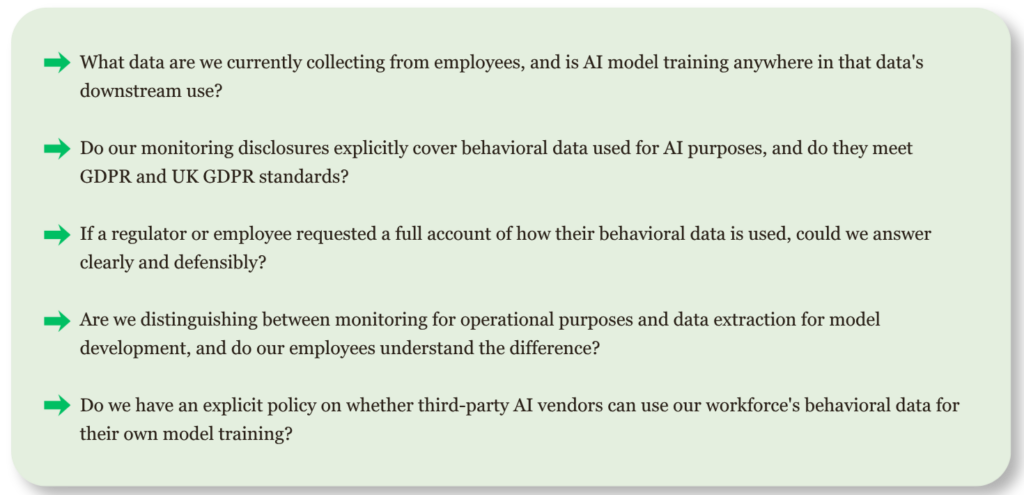
FIVE QUESTIONS EVERY GLOBAL LEADER MUST ANSWER NOW:
The commercial logic of this shift is easy to understand. Behavioral data is uniquely valuable for building the next generation of AI agents. Enterprise workflows are messy, human, and near-impossible to simulate, and the companies that capture them at scale will have a meaningful head start in building systems that function inside real organizations. The incentive to collect is enormous.
But the risk calculus is equally real. Regulators in Europe are not waiting. Labor advocates are organizing. And employees who feel their working lives are being strip-mined for someone else’s AI development will not remain passive, particularly at a moment when they are already anxious about displacement. Companies that draw a clear, transparent line now, distinguishing legitimate operational monitoring from commercial data extraction, will be better positioned legally, and better trusted by the workforces they need to carry through the AI transition.
The industry is betting that convenience and institutional inertia will smooth over the discomfort. They may be right in the short term. But the organizations that will lead in five years are not the ones who quietly harvested the most data. They are the ones who built genuine trust with the people generating it.