Norm Murray | June 23rd 2026 |
Generative AI is performing the roles that justified the promotion of many senior leaders: synthesizing information, generating analyses, and mapping decisions at machine speed. What it cannot replicate is the psychological work of leadership: earning trust under pressure, coaching individuals through transformation, and reading the emotional currents that determine whether a team accelerates or collapses.
A convergence of research, including findings from McKinsey, Gallup, Korn Ferry, and the World Economic Forum, confirms that 70% of the variance in employee engagement traces back to the manager. As AI amplifies organizational dynamics, the gap between high- and low-EI leaders will be measured not in performance reviews but in retention data, adoption velocity, and shareholder value. This article examines the mechanism by which AI renders leadership deficits visible, the specific competencies that determine who thrives, and why the leaders most threatened by AI are not the ones they think they are.

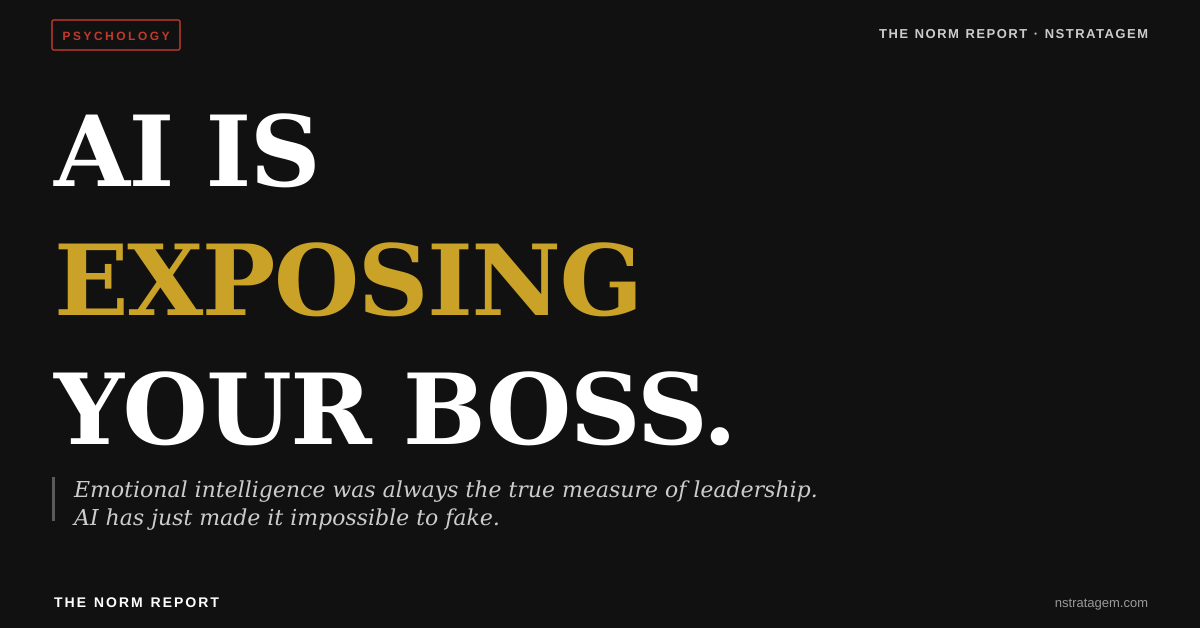
AI Is Exposing Your Boss
The Promotion Was Never About What You Think
In the summer of 2023, Goldman Sachs published an analysis estimating that generative AI could automate tasks equivalent to 300 million full-time jobs globally. The headlines seized on the number. Boardrooms convened emergency sessions. HR teams scrambled for upskilling budgets.
They were looking at the wrong problem.
The disruption AI poses to individual contributors is real but manageable. The disruption it poses to leadership is existential, and far fewer organizations have grasped why. For decades, a particular archetype dominated the executive floor: the brilliant expert who was promoted for what they knew and what they could execute. Technical mastery. Subject-matter authority. The ability to absorb and synthesize large quantities of information and make defensible decisions quickly.
That description now fits a large language model. And it fits it better.
A 2024 McKinsey Global Institute analysis found that AI can already match or exceed human performance across 57% of US work hours in cognitive tasks involving information synthesis, analytical reasoning, and structured decision-making. These are precisely the competencies that filled many corner offices. The performance floor for those skills has not just risen; it has moved to a machine baseline that costs fractions of a senior salary to operate.
What AI cannot do is replicate the deeper architecture of why people follow a leader in the first place. Psychologist Daniel Goleman, whose foundational research on emotional intelligence (EI) has shaped leadership development for thirty years, frames the distinction precisely: influence, inspiration, empathy, coaching, conflict resolution. These are not soft skills. They are the structural load-bearing elements of organizational performance that no current AI can approach.
“People do not resist technology. They resist the feelings that come with change. AI doesn’t just change the work. It accelerates the emotional dynamics already at play.”Daniel Goleman, Korn Ferry Contributor
The Amplification Effect
What makes this moment structurally different from prior technological transitions is not the speed of automation. It is the amplification dynamic AI introduces into organizational culture.
This is the amplification thesis: whatever relational patterns exist within a team, AI accelerates them. High-trust environments, where communication is direct and psychological safety is established, experience AI adoption as momentum. The technology multiplies the capability of already functional people. Low-trust environments, where anxiety is ambient and direction is ambiguous, experience AI as an accelerant on the fire.
Gallup’s 2025 State of the Global Workplace report found that only 21% of employees worldwide are engaged at work, while 62% are quietly disengaged and 17% are actively disengaged. Those numbers reflect leadership quality more than any other single variable. Gallup’s own research, spanning decades and 35 million employees, demonstrates that 70% of the variance in team engagement is directly attributable to the manager.
Now map AI onto that population. In organizations where 21% of employees are engaged, AI adoption will be led by motivated, creative people who build momentum. In the remaining 79%, AI will arrive as another top-down initiative, half-implemented, poorly socialized, and eventually abandoned, with the failure attributed to the technology rather than the leadership that introduced it.
The failure will not be the technology’s fault.
The Leadership Exposure Matrix
Not all leaders face the same exposure. The risk profile depends on the intersection of two variables: the depth of an individual’s emotional intelligence and the rate at which their organization is integrating AI into core operations. The leadership exposure matrix below maps this dynamic across four distinct zones.

The most dangerous zone is not the one most executives assume. It is not the low-EI, low-AI quadrant, where leaders are temporarily insulated by the slow pace of transformation around them. The highest-risk position is low-EI combined with high AI adoption: a leader whose relational deficits are now being amplified at machine speed. Every ambiguous communication, every failure to acknowledge anxiety, every meeting where presence was substituted for purpose is now playing out across a team that processes information faster, compares notes more efficiently, and has more options for quiet exit.
Which Skills Survive?
The World Economic Forum’s Future of Jobs Report 2025 identified emotional intelligence, creative thinking, and complex reasoning as among the highest-growth skill demands over the next five years. These are not platitudes. They reflect a structural recalibration in what creates economic value in organizations where AI handles the rest.
The skills survival analysis below draws on McKinsey’s automation vulnerability research, WEF’s future-of-work projections, and nStratagem’s proprietary competency scoring to rank leadership capabilities by their resistance to AI substitution.

The data carries a counterintuitive message for leaders accustomed to being valued for analytical horsepower. The skills at the top of the survival index are not the ones emphasized in traditional MBA programs or leadership development curricula. Empathy, conflict resolution, coaching, and strategic influence are survivorship assets precisely because they operate in the domain AI cannot access: the psychology of human motivation.
The EI Competency Gap Is Already Measurable
Korn Ferry’s analysis of 55,000 leaders across industries found that self-awareness, one of the foundational components of emotional intelligence, is the competency most correlated with leadership effectiveness. It is also among the most consistently underdeveloped.
More troubling: a 2023 DDI Global Leadership Forecast surveying 13,695 leaders in 1,556 organizations found that only 40% believe their organization effectively develops leaders. Less than half of leaders report receiving feedback that helps them improve. In environments already underinvesting in leadership development, AI is about to make that gap expensive.
Harvard Business Review research correlates emotionally intelligent leadership with 20% higher revenue per employee and meaningfully lower voluntary turnover. When MIT Sloan and Boston Consulting Group studied AI adoption outcomes across 1,500 companies, organizations with strong change management leadership (a proxy for EI) reported three times better outcomes from AI implementations than those without.
The economic case for emotional intelligence is no longer a values argument. It is a returns argument.
The EI Leadership Audit
The radar below provides a diagnostic frame for mapping leadership profiles against the competencies that will determine AI-era effectiveness. The three profiles, AI-Ready Leader, Average Manager, and Low-EI Executive, are drawn from composite data across Goleman’s EI Competency Model and Korn Ferry’s Leadership Architect Framework.
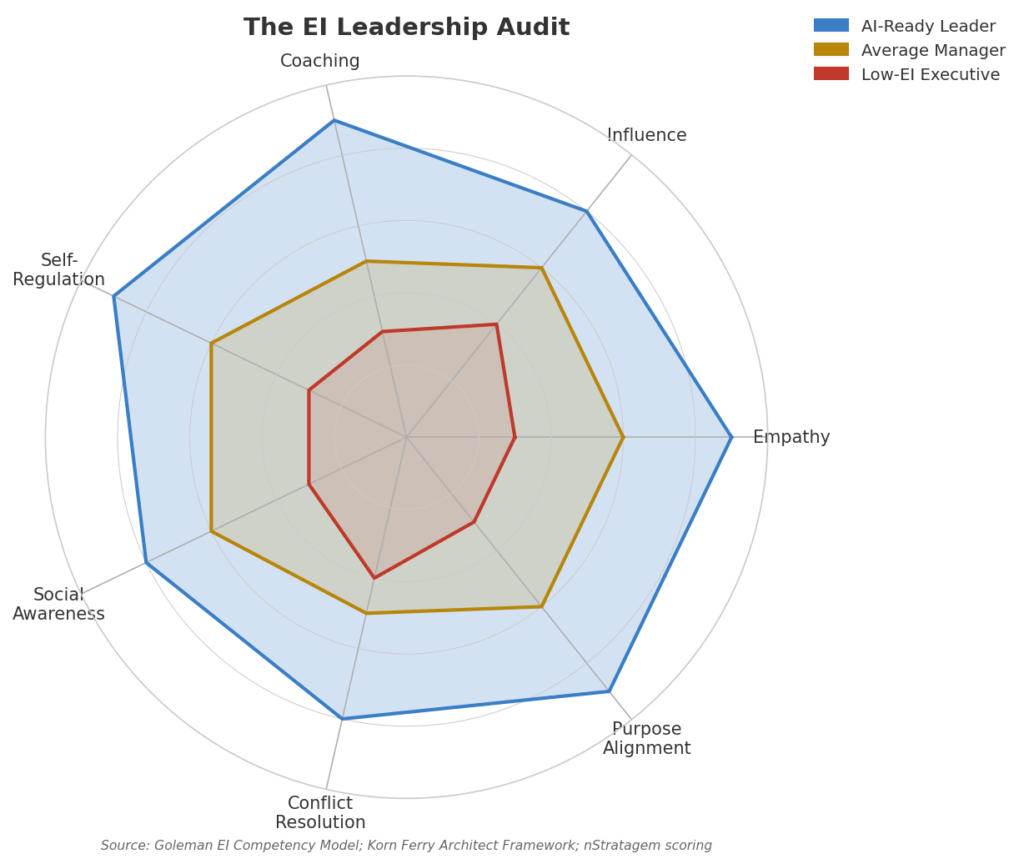
The divergence between profiles is not a judgment about intent. Most low-EI executives are not indifferent to their teams. They are simply operating with a self-model that was calibrated in a different era, one where expertise and execution were sufficient to produce results. AI has removed the floor that made that model viable.
What This Means for Boards and Executive Teams
Boards evaluating leadership succession should reframe their evaluation criteria. The traditional indicators, operational performance, financial delivery, institutional relationships, remain necessary but insufficient. The question is whether a leader can function as a stabilizing psychological force as AI restructures how work is organized, how decisions are made, and how value is created.
Several governing principles follow from this analysis.
First, AI readiness assessments should include leadership EI profiling as a core metric. Organizations deploying AI into operations led by low-EI executives are making a structural error. The adoption failure rate will be attributed to the technology when the causal variable is the leadership.
Second, coaching and mentoring at the executive level requires rehabilitation as a discipline, not a corrective intervention. LinkedIn Learning’s 2024 Workplace Learning Report identified emotional intelligence as the most in-demand soft skill across industries. The demand is not aspirational. It reflects what hiring managers are actually discovering is missing.
Third, the middle management layer deserves particular scrutiny. Senior executives often have the EI benefit of long careers, a wide feedback network, and coaches. Middle managers, responsible for the day-to-day AI transition experience of the majority of employees, frequently have none of these resources. This is where AI adoption will be won or lost.
Finally, organizations should take seriously the asymmetric risk profile embedded in AI transformation. The upside of AI-capable leadership is measurable and compounding. The downside of AI-exposed leadership is erosion: of trust, of talent, of competitive position. Both outcomes are leadership outcomes.
| Finding | Source | Implication |
| 70% of engagement variance attributable to manager | Gallup, State of Global Workplace 2025 | Manager EI is the primary organizational lever |
| AI could automate 57% of US work hours in cognitive tasks | McKinsey Global Institute, 2024 | Analytical roles face highest displacement risk |
| Companies with high-EI leadership see 3x better AI outcomes | MIT Sloan / BCG, 2023 | EI is an AI adoption multiplier |
| High-EI leaders generate 20% more revenue per employee | Harvard Business Review | EI has a direct financial ROI |
| Only 40% of leaders say their org develops leaders effectively | DDI Global Leadership Forecast, 2023 | EI development is critically under-resourced |
| EI is the #1 most in-demand soft skill across industries | LinkedIn Learning, 2024 | Market demand is already pricing EI at a premium |
| 39% of existing skill sets will be disrupted in 5 years | WEF Future of Jobs Report, 2025 | Skill portfolios require active redesign now |
The Invitation, Not the Threat
Dan Goleman’s framing is worth returning to in conclusion: for leaders willing to grow, this is not a crisis. It is an invitation.
But the invitation has a closing date, and it is closer than most organizations acknowledge. The leaders who will define the next decade of organizational performance are those who understand that AI has not fundamentally changed what leadership requires. It has simply stripped away the environments in which poor leadership could hide.
Trust could always be earned or forfeited. AI has made the accounting real-time.
Empathy was always the lever that determined whether change produced momentum or resistance. AI has put that lever under continuous load.
Coaching was always the mechanism by which organizations built adaptive capacity. AI has made that capacity existentially important.
The leaders who thrive will not be those who learned to use AI tools the fastest. They will be those who understood that AI is a mirror, and had the discipline and self-awareness to look clearly at what it reflected.