It’s Friday afternoon. Your team looks exhausted. Not the good kind of tired that comes from deep, meaningful work, the frazzled, glazed-over kind. Tabs everywhere. Slack pinging. Three AI tools open at once, none of them quite delivering what was promised.
This is what researchers are now calling “AI brain fry” – and if you lead a team in 2026, it’s almost certainly happening on your watch.

AI BRAIN FRY
The Productivity Trap Nobody Warned You About
The pitch was simple: give your people AI tools, watch output soar, maybe even get a few hours back. And in pockets, it has worked. But the fuller picture is considerably messier.
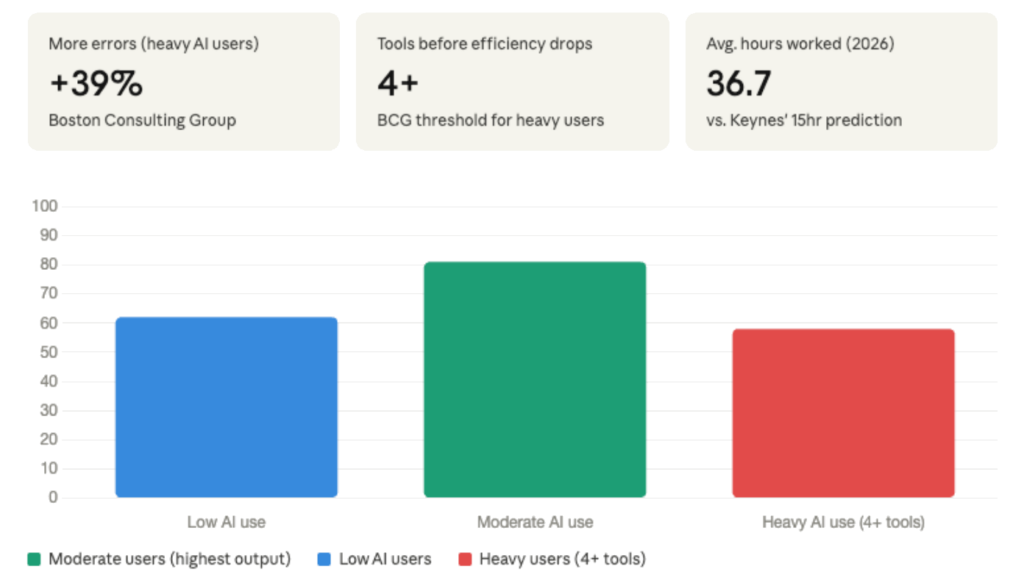
Research from the Boston Consulting Group found that while AI boosted productivity for moderate users, heavy users, those juggling four or more AI tools simultaneously, were less efficient than colleagues who used fewer. They also made 39% more significant mistakes. Not a typo. More tools, more errors.
Key findings:
Meanwhile, a study from ActivTrak found that AI users are spending significantly less time in focused, uninterrupted work than those who aren’t using AI at all. And this week, Harvard Business Review put a name to the creeping malaise your team may already be feeling: mental fatigue from excessive AI oversight, loss of focus, rising stress, a persistent sense of never quite getting enough done.
The cruel irony? The tools designed to take work off people’s plates are adding a new layer of cognitive labor on top. Managing AI agents, prompting them, waiting, tweaking, re-prompting, it’s not rest. It’s a new kind of work, and it’s relentless.
What Leaders Are Getting Wrong
Most organizations have approached AI adoption as a volume game: more tools, faster rollout, bigger promises. What they’ve underestimated is the human cost of context-switching at scale.
Every time someone pivots from managing an AI output to answering a message to reviewing another bot’s draft, they’re burning cognitive fuel. And unlike a spreadsheet, AI tools create a subtle pressure to stay on them, because the output is never quite finished, never quite right, always one more prompt away from better.
Add to this the existential undercurrent many employees are quietly navigating, is this tool here to help me, or replace me?, and you have a workforce that is not just tired, but emotionally depleted.
Elizabeth Marsh, a digital workplace researcher, describes it as a “vicious cycle of information overload and fear of missing out.” AI, she says, is making it worse.
Five Things You Can Do Today
1. Audit the tool stack, ruthlessly. Ask your team honestly: which AI tools are genuinely saving time, and which ones just create more to manage? Cut anything that isn’t clearly earning its keep. Complexity is the enemy of focus.
2. Protect deep work time. Block at least 90-minute windows in the day where AI tools are put down and people work in single-task mode. The research is unambiguous: focused work produces better output than fragmented, AI-supervised multitasking.
3. Stop rewarding volume, start rewarding judgment. If your team believes that AI means they should be producing more, they’ll never stop. Explicitly tell them that better decisions, clearer thinking, and smarter prioritization matter more than raw output. Mean it.
4. Check in on how people actually feel about AI. Not in a survey. In a conversation. Some of your best people may be quietly overwhelmed, reluctant to say so because everyone else seems to be embracing the tools enthusiastically. Create space for honest pushback.
5. Model a saner relationship with AI yourself. If you’re forwarding AI-generated briefings at 10pm and expecting responses by 8am, no amount of wellbeing messaging will land. The tone is set at the top.
The Bottom Line
Technology has always promised us more time and delivered us more expectations. AI is no different, unless leaders make deliberate choices to break that pattern.
Your team doesn’t need more tools this week. They need permission to put some of them down.
That’s a decision only you can make. And right now is a pretty good time to make it.
Moderate AI use maximizes output. Beyond four tools, error rates increase and productivity declines. This is not a tooling issue. It is a cognitive architecture failure.