
There is a leaderboard inside Meta. Two hundred and fifty employees compete to top it. Their metric: how many tokens they have consumed. Not how many products shipped. Not how many customers retained. Not how much revenue generated. Tokens. Units of AI processing. The digital equivalent of measuring how many keystrokes a typist makes per day and calling it output.
Welcome to tokenmaxxing, the 2026 corporate productivity theater that is simultaneously the most expensive and most hollow performance in recent business history. And if you are an executive who has introduced, tolerated, or applauded it, this analysis is addressed directly to you.
Why Smart People Do Performatively Stupid Things
Tokenmaxxing is not a technology problem. It is a behavioral one. And it follows a pattern that organizational psychologists have documented across every major technological transition of the last 50 years: when the pressure to adopt outpaces the capacity to measure, people optimize for visibility.
The behavioral mechanics here are textbook. When evaluation criteria are ambiguous, “embrace AI” is not a KPI, employees default to proxies that are visible, countable, and defensible. Tokens are countable. They show up on dashboards. They can be presented in quarterly reviews. They create the appearance of engagement without requiring the harder, messier, more time-consuming work of demonstrating actual productivity gain.
Psychologists call this Goodhart’s Law in action: when a measure becomes a target, it ceases to be a good measure. Economists recognize it as a principal-agent problem, employees (agents) are responding rationally to the incentives set by management (principals), even when those incentives produce outcomes that actively harm the organization. Amazon employees reportedly running AI systems through unnecessary tasks to inflate their adoption scores are not rogue actors. They are rational employees responding to a broken incentive architecture.
“If you say to everyone ‘burn a bunch of tokens’, then you’re going to burn a bunch of tokens. But it’s not a valid measure of productivity.” JAMES GOVERNOR, FOUNDER, REDMONK
There is a deeper psychological layer here, too. Tokenmaxxing exploits something called effort heuristics, the cognitive shortcut by which humans equate visible effort with quality output. We see it in presenteeism: the employee who stays late to be seen, not to be productive. We see it in verbose email chains that demonstrate “thinking” without advancing decisions. Tokenmaxxing is presenteeism for the AI age, except it costs exponentially more, and the bill arrives monthly.
The Financial Reckoning No One Modeled
Let us be precise about the financial stakes, because the numbers are not theoretical.
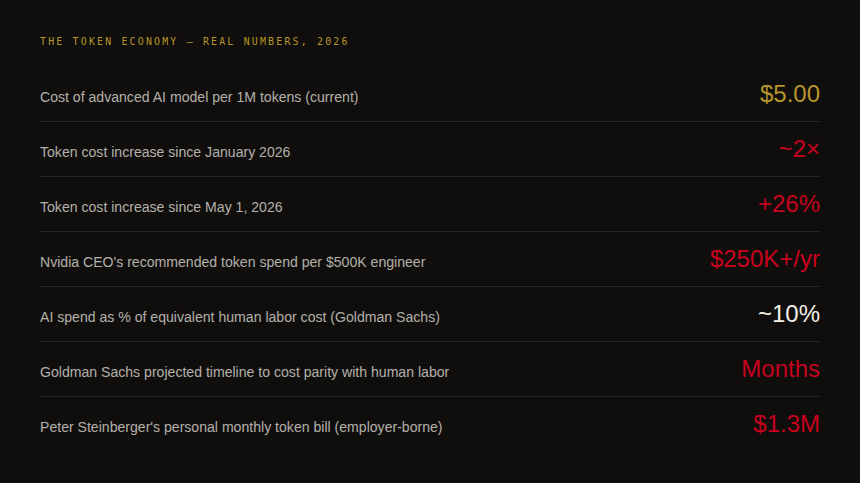
Uber burned through its entire annual AI budget in under four months. This was not a planning failure in isolation, it was a failure of governance. No budget framework, no return threshold, no spend trigger that prompted a conversation. Just consumption, until the number became impossible to ignore.
What makes this economically alarming is the direction of travel. Token costs have nearly doubled since January 2026, driven by demand for the latest, most capable models and by the proliferation of agent architectures that chain AI calls into overnight loops. Agents consume dramatically more compute than a single chatbot interaction. A swarm of agents running through a weekend doesn’t cost like a chatbot session. It costs like a small data center.
Jensen Huang’s token spend thesis, that a $500K engineer should expense an additional $250K annually on tokens, deserves scrutiny proportional to its source. Nvidia manufactures the chips that process those tokens. When the world’s most prominent chip executive tells you to buy more chips, you should probably model your own ROI rather than accepting his as a benchmark.
“Most organisations are just not in a world in which they can practically spend those sorts of sums on productivity that is not proven.”
— JAMES GOVERNOR, FOUNDER, REDMONK
The Goldman Sachs projection that AI spending could reach cost parity with human labor within months is not a celebration, it is a warning. It means organizations are approaching a moment where the substitution logic that justified AI investment must be rigorously stress-tested. Right now, most are not doing that math honestly.
Four Signs Your Organization Has A Tokenmaxxing Problem

If two or more of these apply, your organization is not in an AI productivity story. It is in an AI theater story. The difference matters enormously, both to your P&L and to your credibility with shareholders who are increasingly sophisticated about this distinction.
Shareholder Pressure Created This. Governance Has To End It.
Tokenmaxxing is not an employee problem. Let that land. Employees at Amazon, Meta, and Uber are not gaming systems out of laziness or bad faith. They are responding with perfect rationality to the signals their organizations have sent: adopt AI visibly, or be seen as behind.
Those signals originate in the boardroom and on the earnings call. Executives facing investor pressure to demonstrate AI adoption created adoption dashboards. Adoption dashboards created token leaderboards. Token leaderboards created the incentive to run AI agents overnight doing nothing useful. The causal chain runs from shareholder expectation to sawdust metric.
This is a governance failure at its root. And it has a compounding consequence: as AI companies prepare for IPOs, both OpenAI and Anthropic are reportedly targeting stock market listings as early as this year, the pricing pressure on tokens is unlikely to decrease. Loss-making AI companies need revenue. Revenue requires pricing discipline. The era of cheap tokens, if it ever truly existed at enterprise scale, is closing.

What The Inflection Looks Like – And What To Do Before It Arrives
The inflection is already visible. Target is re-evaluating AI strategy over costs. Duolingo’s CEO has reversed course on mandatory AI usage metrics. Uber’s COO is openly acknowledging the ROI ambiguity. These are not failures of AI, they are corrections of flawed implementation governance. They are the market doing what markets do: demanding accountability for capital deployed.
The executives who emerge well from this correction will be the ones who get ahead of it. That means making three moves now, before the board meeting where someone asks for a line between AI spend and EBITDA, and you don’t have an answer.
First: retire the activity dashboard. Usage volume is not a business metric. Replace token counts with outcome proxies, feature velocity, error rates, time-to-resolution, customer satisfaction deltas. If AI is genuinely productive, those numbers will improve. If they don’t, you need to know that urgently.
Second: install spend governance with teeth. Team-level token budgets, forecast models, and escalation thresholds. When a CFO falls off his chair at the first AI bill, that is a governance failure, not a finance failure. The bill should not have been a surprise.
Third: separate the adoption narrative from the ROI narrative.Communicating to shareholders that your organization “embraces AI” is a reputational claim. Demonstrating that AI spend produces measurable returns is a financial claim. The former without the latter is a liability. In 2026, sophisticated investors know the difference.
As Bola Rotibi of CCS Insight observed, the fervour will be revisited. Leaders will demand clearer links between AI spend and proven outcomes. The question is whether you build that linkage proactively, or reactively, in a quarterly call where the numbers don’t support the narrative you’ve been telling.
Tokenmaxxing will end. The only question is whether it ends on your terms, or someone else’s.
[© Copyright 2026. Norm Murray. All Rights Reserved.]